The French racing driver, Jean-Pierre Wimille, lived an eventful life, one that was interrupted by the tragic events in Europe between 1939 and 1945, but his remarkable skill behind the wheel of a grand prix car has not been forgotten by a handful of connoisseurs of grand prix racing, as testified by the presence of his statue erected at the end of the Bois de Boulogne in Paris.
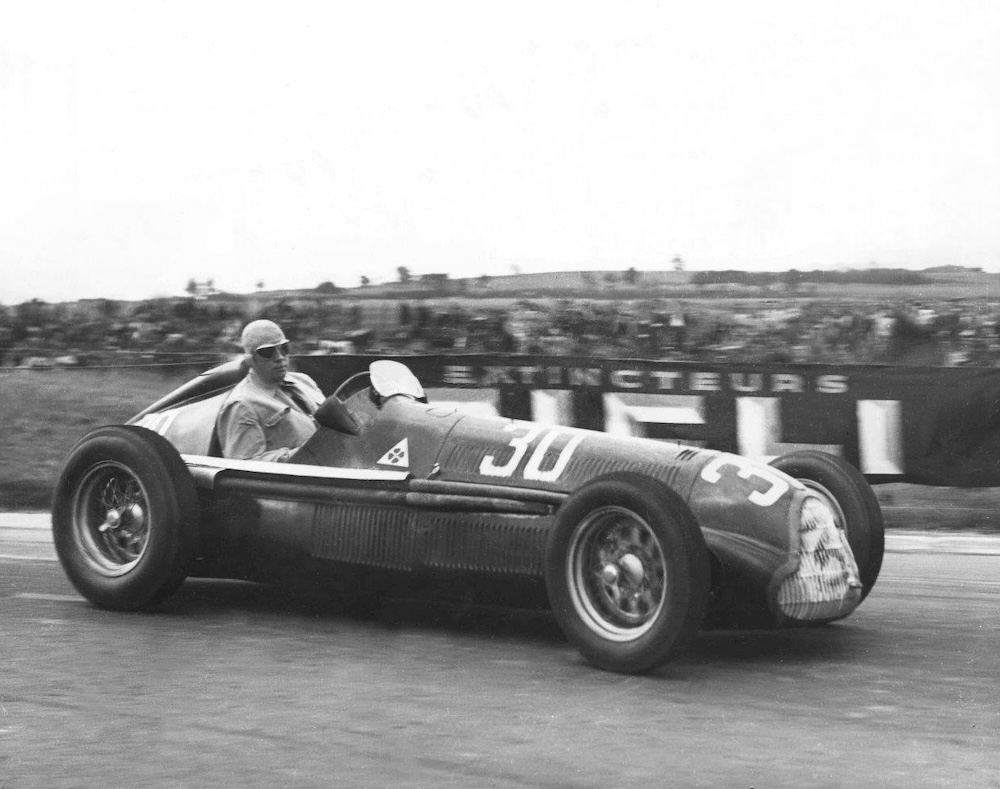
1948 ACF GP Alfetta 159 Wimille
Inspired by the exploits of the French driver Robert Benoist, Wimille began his racing career in 1930 at the wheel of a borrowed Bugatti and the following year he was loaned a Bugatti Type 51. The following season that he began to be noticed when he competed in hillclimbs and grand prix with considerable success before, while in the lead of the 1932 French grand prix, he rolled his car but survived. In 1933, his driving was less aggressive and, as a consequence, his results improved sufficiently to be offered a drive by Ettore Bugatti in his team alongside his hero, Benoist. However, by 1934 the cars were no longer competitive with those from Mercedes-Benz and Auto Union so Bugatti turned his attention to sports car racing, especially the Le Mans 24 Hours. In 1937 Wimille and Benoist drove a Bugatti 57G ‘Tank’ to victory at Le Mans, making Wimille one of only four drivers to win at their first attempt. He still had a desire to race single-seaters so accepted an offer to race Alfa Romeos with Enzo Ferrari’s team but these too struggled to compete with the German cars. A further win at Le Mans followed in 1939 but then all motorsport ceased and Wimille turned his attention to automobile design, creating a radical aerodynamic-bodied car that he planned to put into production (he succeeded in building eight cars in 1946) but his projecy was interrupted when Benoist persuaded him to join the French Resistance. In 1944 he narrowly escaped capture, unlike Benoist, and following D-Day he joined the Free French Air Force.
Gradually motorsport returned and he was in demand, electing to drive for the official Alfa Romeo team in international races with a proviso that he drove for the French manufacturer Gordini in French races. At the time there were no official world championship for cars or drivers but his record of victories would have seen him become the world champion in 1948. One of his most notable races was the Grand Prix of Rosario where he did battle with Juan Manuel Fangio. Driving identical cars, Wimille took an early lead before Fangio found a way past but Wimille would not be deterred. He found a way to retake the lead and fought off Fangio’s determined attempts before his engine expired and Wimille took a deserved win. With two such skilled drivers in the sport, the future of grand prix racing held considerable promise but it was not to be; in 1949, Wimille died when he crashed his Simca-Abarth while practising for the Argentine grand prix. The prospect of Fangio, Moss and Wimille competing against each other would have made headlines. The photograph shows Wimille at the wheel of his Alfa Romeo 158 during the 1948 French grand prix held at the Reims road circuit where he secured pole position and the fastest lap in addition to leading his team to a 1 – 2 – 3 victory.