During the aftermath of First World War, followed later by the 1929 world economic crisis, every automobile manufacturer was adversely affected but despite this motorsport continued until, in 1932, the governing authority established a new formula for single-seater grand prix cars, the most notable regulation being a dry weight limit of 750kg.
A new series of European races were introduced with several major car producers being persuaded to compete, not least Mercedes-Benz. In spite of the cost the senior management were of the opinion that the company needed the publicity that grand prix victories would bring. As soon as the board of Mercedes-Benz gave its consent, its engineers and designers set about creating an entirely new car, titled the W25, since the previous competition model, the large, heavyweight 7-litre SSK was no longer competitive. The new regulations came into force at the start of 1934 and the W25 was unveiled, powered by a new in-line 8-cylinder 3364cc engine that was later enlarged in order to remain competitive with the cars of its rivals, Auto Union and Alfa Romeo. The first W25 was completed in January 1934 and tested on an Italian autostrada. Its first scheduled race, held at the Avus circuit in May, saw the cars withdraw following mechanical problems during practice but a week later Manfred von Brautisch recorded the first race win for the W25 at the Nurburgring.
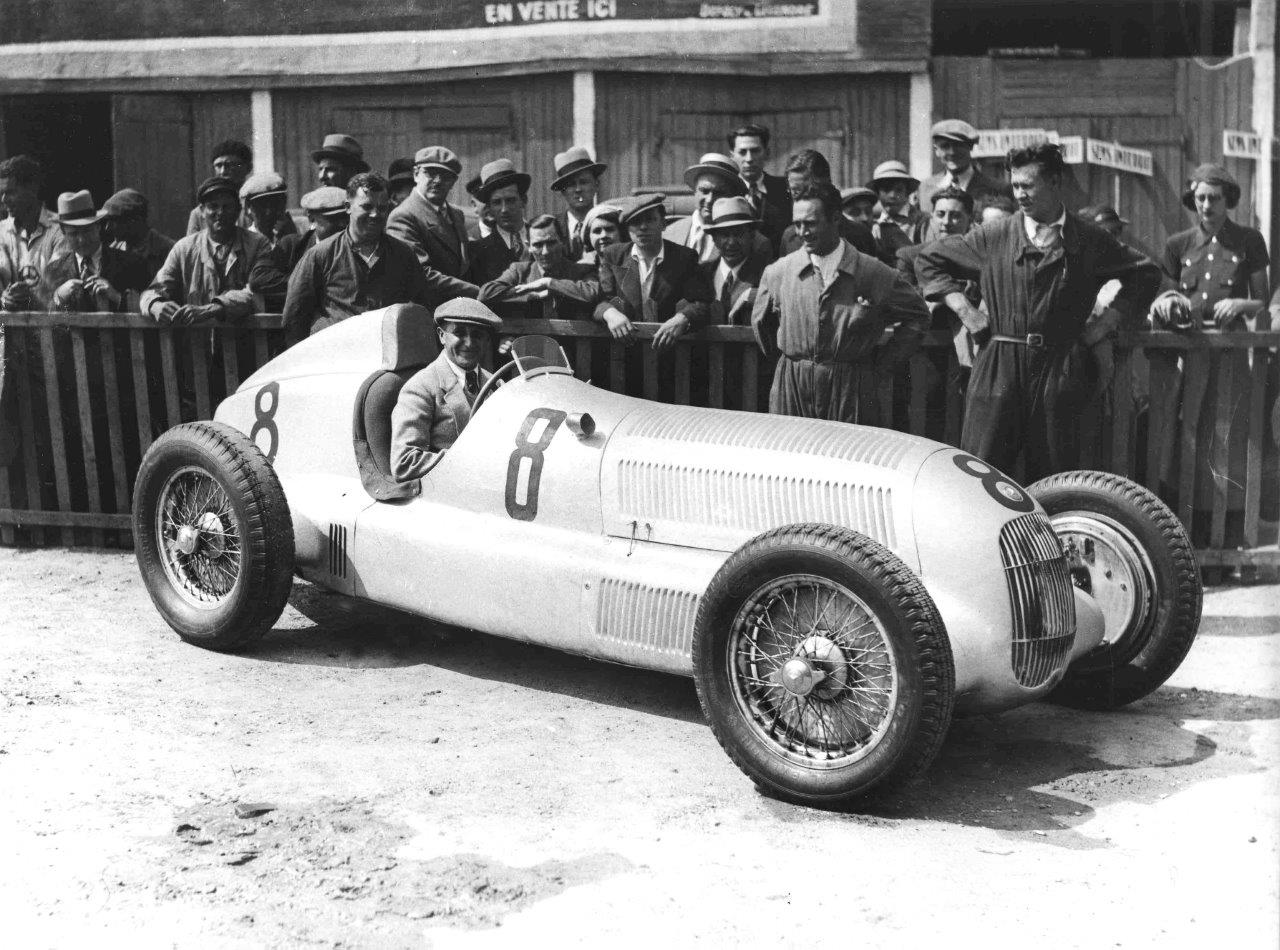
Legend has it that this race was responsible for the creation of the ‘Silver Arrows’ title for Mercedes-Benz competition cars of the era, despite the fact that it had first appeared in a race report some years earlier. The cars arrived for the race painted in the national colour, white, but failed scrutineering due to being one kilogram overweight. Having spent months ensuring that every part was as light as possible, it was decided the quickest way to lose the weight would be to remove the paint and polish the silver aluminium body panels. The W25, in various forms, continued to race in this form as it went on to win numerous European championship races and grand prix before being replaced by a revised model, the W125 in 1937. The photograph shows the Mercedes-Benz W25 of Rudolph Caracciola parked in the pits at Montlhery prior to the 1934 French grand prix. The race proved to be disastrous for both German teams since none of the six cars entered finished the race, allowing Louis Chiron to record a rare victory for Alfa Romeo.