Arguably the most significant design change to post-war grand prix cars occurred when the British team, Cooper, moved the engine from the front to the middle of the car, behind the driver. In 1958 Stirling Moss drove his Cooper to victory in the 1958 Argentinian grand prix while Jack Brabham won the World Championship in 1959 and 1960.
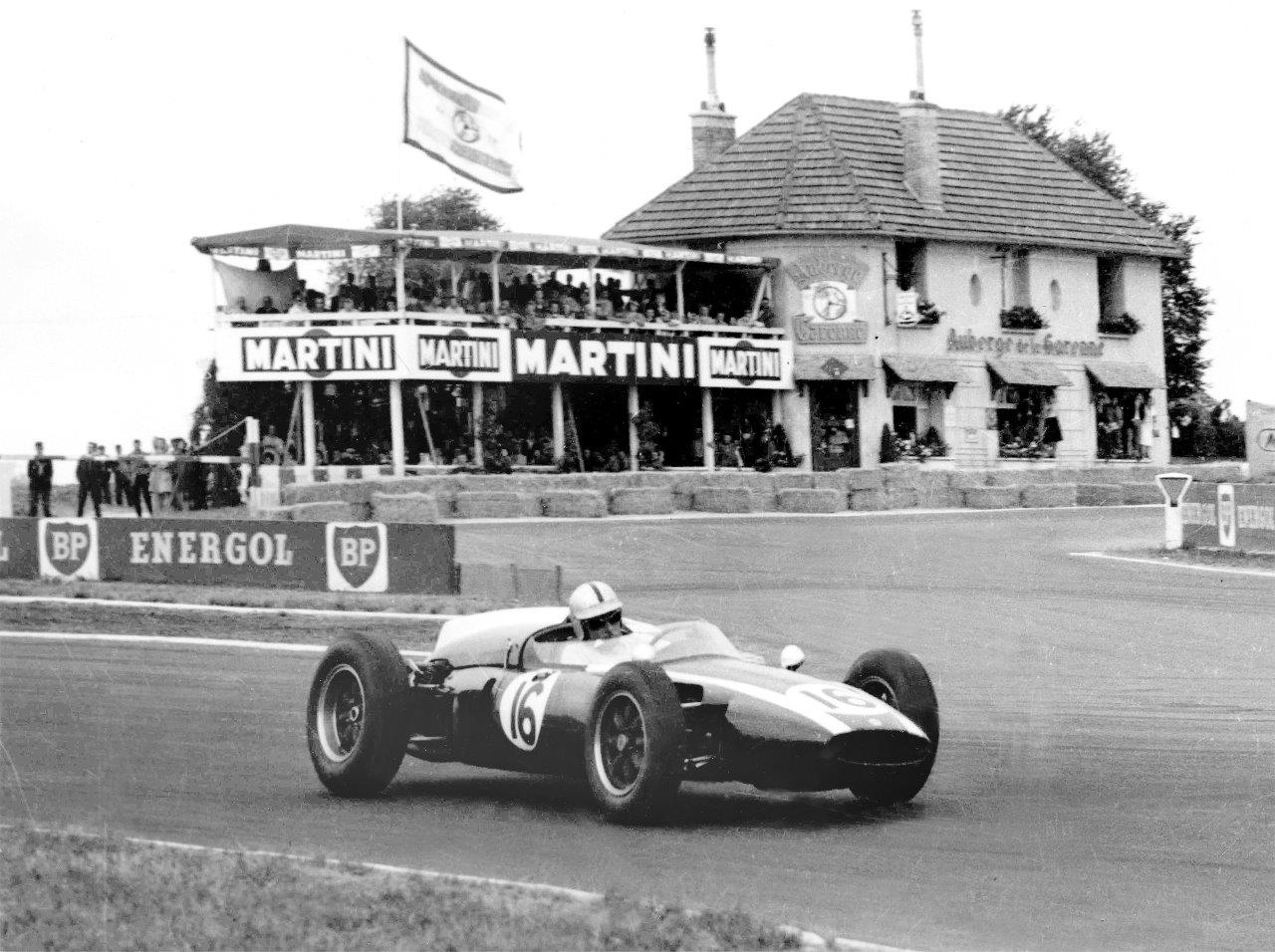
1960 ACF GP Cooper Brabham 16
The other teams had little option but to accept that a mid-engined design offered numerous benefits such as lower weight, a smaller frontal area as well as responsive handling and road-holding; they were left with no alternative but to follow suit. The concept, as is so often the case, was not a radical new invention having been adopted several times in the past; Benz created a rear-engined competition car in 1923 while Auto-Union introduced its successful grand prix car in 1934. The Cooper Car Company, created by Charles and John Cooper, had previously experimented with mid-engined race cars in the early 1950s but although these competed in World Championship races they were essentially Formula 2 cars powered by lightweight motorcycle engines. When the Cooper team eventually built a car to Formula 1 regulations, with a 2.5-litre Climax engine installed behind the driver, they paved the way for future Formula 1 car design. If proof were needed, the new Cooper won the World Championship in 1959 and 1960 with Jack Brabham securing the drivers title in the process. The photograph shows Brabham in his Cooper-Climax T53 en route to winning the French grand prix in 1960, a race held at the closed-road circuit, Reims, and was the sixth race in a ten-race championship that saw Brabham win five consecutive grand prix to take the title from his team-mate, Bruce McLaren. As the circuit featured two long straights where top speed was paramount, Phil Hill was initially able to offer a strong challenge on behalf of the front-engined cars, driving his Ferrari 156 to the limit as he and Brabham swapped the lead for lap after lap until the Ferrari’s transmission began to falter. Cooper-Climax cars finished in the first four places at the chequered flag.