Unless you live in Pleasantville, precautions against car theft are routine practice. Lock the doors. Park in the garage overnight. Maybe fit “The Club,” a car alarm, or a kill switch/battery disconnect. Old schoolers have been known to carry the distributor rotor in their pocket. All of these measures are effective to some degree, but what about when your car isn’t physically with you, in your care?

When a car is being transported to a buyer from hundreds or thousands of miles away, it can fall into the hands of criminals without warning. It even happens to the rich and famous. Late last year, basketball legend Shaquille O’Neal had his his $180,000 Range Rover, customized to fit the ex-center’s 7-foot-1 frame, stolen in Georgia. The SUV was scheduled for shipment to Louisiana for O’Neal to use while he was in town for a game at his alma mater, LSU, but the Range Rover was soon in the wind. According to ESPN.com, the carrier, FirstLine Trucking LLC, reported that its system was hacked.
There’s a relatively new, sophisticated, and frustratingly common type of fraud affecting collector cars when they are at their most vulnerable, so we reached out to the experts to see what it is, how it works, what is being done to stop it, and what you can do to prevent it.
A Novel Way to Steal a Car
It’s called transport or cargo theft, and it’s big business for bad actors. Cargo theft—which includes cars in addition to any other type of freight—costs the trucking industry more than $18M a day, according to the American Trucking Associations. “It has become a criminal enterprise that has resulted in billions of dollars in lost goods. From electronics to clothing to food, nearly every industry has felt the sting,” the ATA says.
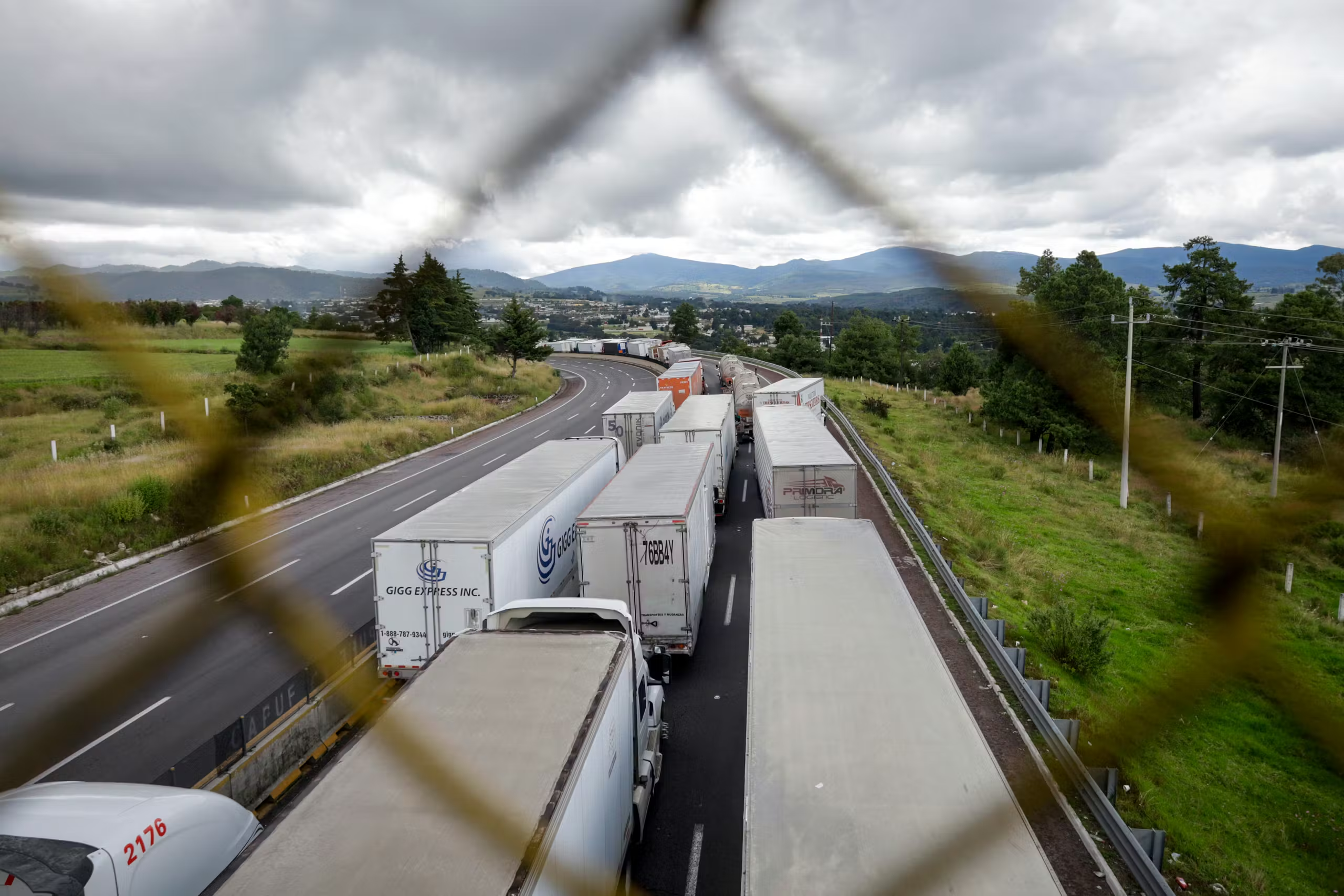
While a portion of these losses is the type of snatch-and-grab, or “straight” cargo theft you might envision, the more insidious type is called “strategic” theft. This method, the FBI notes, “involves the use of fraud to trick shippers, brokers, and carriers into handing loads over to thieves instead of the legitimate carrier.”
“The industry has a lot of middlemen,” says Hagerty’s Ray Santos, a senior investigator at Hagerty’s Special Investigations Unit (SIU). Formed in 2013 with two investigators, the unit has since expanded to include a roster of 22 employees. “Transporting a car is an inherently convoluted process, with layers of people and technology, which is why it’s so vulnerable. A load can change hands multiple times in a 24-hour period.” According to SIU—which also deals with fraud related to insurance claims and policies, bogus sales or consignments, and illegitimate or fictitious dealers—cars are stolen in shipping fraud schemes in North America every single day.
That car you just bought from three states away? Bad actors can try to wriggle their way into the transaction, perhaps via social engineering scams or hacking by way of phishing emails. By the time you figure out your car was loaded on the wrong truck, or the unsuspecting driver was given a bogus address where to drop it off, that vehicle is long gone. And you’re the one left holding the bag.
The ATA reports that strategic theft of this sort has risen by a staggering 1500% between 2021 and mid-2025. Given the risk involved, auto thieves that target transports tend to have high-end and/or exotic cars in their crosshairs, so the average theft is valued at more than $200,000. Each year, the U.S. economy suffers up to $35M in losses from these crimes.
Senior Hagerty SIU investigator Dereck Tharp, who monitors California, has witnessed this phenomenon grow dramatically over the last five years. “Somebody starts doing it, and if another criminal organization gets a hold of the playbook, then it just intensifies. One group turns into several in a hurry.” While cargo theft is nothing new, it has hit the car shipping industry particularly hard since the pandemic. The rise in out-of-state, all-digital transactions since 2020 has led to rich hunting grounds for savvy criminals.
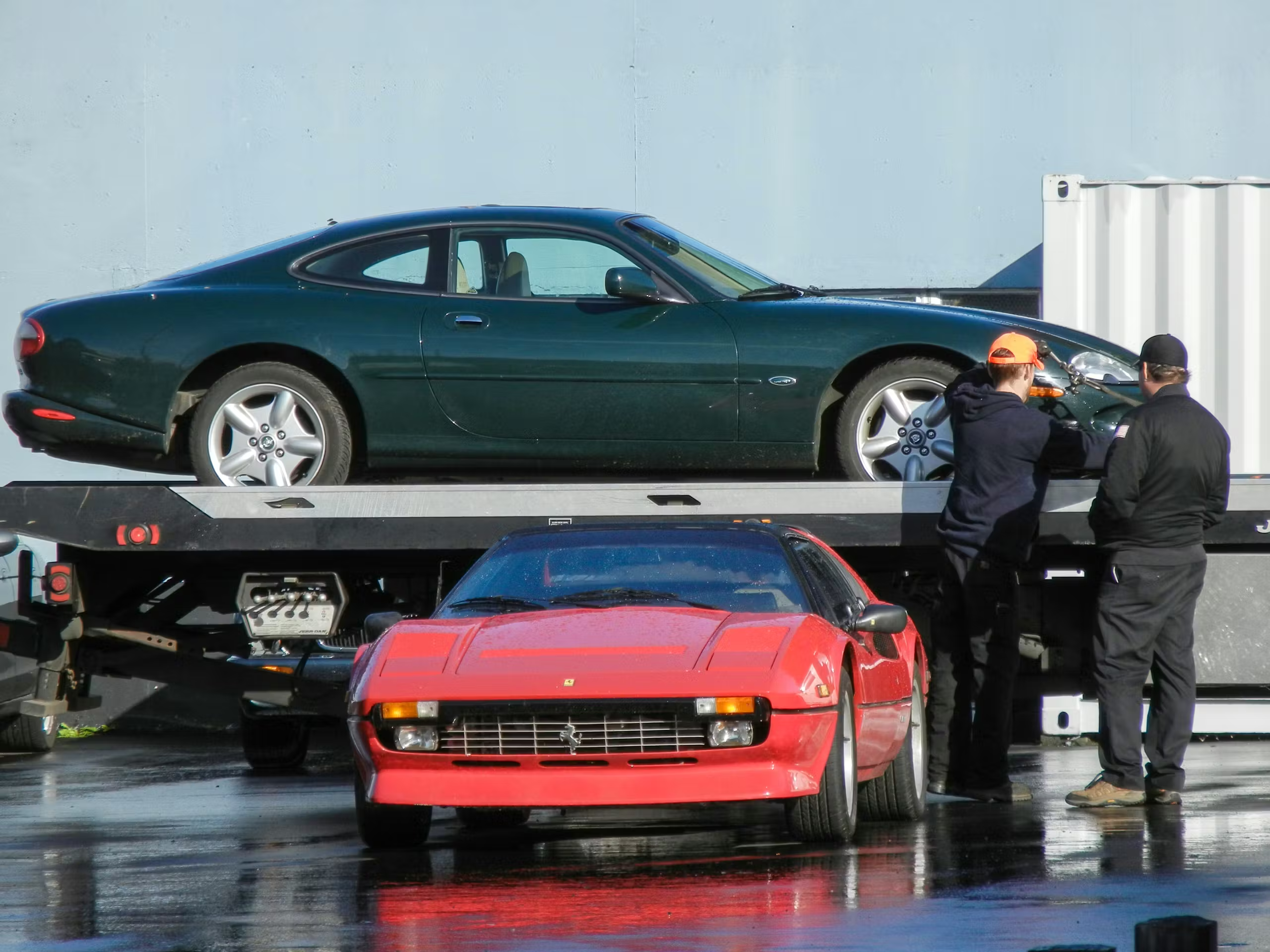
How exactly does this type of fraud and theft work? First, let’s cover the players involved in a normal transaction:
- Shipper: The person initiating the transaction, usually with a broker, who needs the vehicle moved from Point A to Point B.
- Broker: A business that fields the shipper’s request and attempts to assign their business to a truck/transporter to handle the pickup and delivery.
- Load board: A digital bulletin board where leads are posted, such that drivers/trucking companies can find them and compete for the business.
- Carrier: The driver or trucking company assigned to deliver the vehicle from point A to B.
And here’s a very basic rundown of how that normal transaction goes:
Step 1: Request and quote
- You put in a request to have a car shipped, including all relevant details: origin and destination, what kind of car, whether it runs and drives, approximate value, what type of transport, etc.
- You place this request either directly with a broker or on a website where brokers can compete for your business.
- The broker sets the price based on market conditions. Let’s say $1000, for the sake of this example.
Step 2: Brokering
- Broker posts your request, or lead, onto a load board.
- Broker seeks to match your lead with a carrier. For the $1000 quote, let’s say the carrier charges $800.
- Broker pockets the difference of $200.
Step 3: Shipment
- Carrier picks up vehicle from point A.
- During transit, the broker is usually the point of contact for the shipper, ideally providing updates on progress and advising of changes in plans due to traffic, weather conditions, etc.
- Delivery completed to point B.
Those familiar with the process, at least from a consumer perspective, can vouch for how opaque and arbitrary it can be. I’ve personally been told by a broker that I could expect the driver either Wednesday or Thursday to meet me at a local park’s surface lot, only for the driver to call me Tuesday morning, out of the blue, and say he was waiting for me at a Kroger supermarket parking lot on the other side of town.
Against that backdrop, given all the logistical and bureaucratic friction between shipper and carrier, there is a wealth of exploitable vulnerabilities, and bad actors can secretly insert themselves into the process.
How the Scam Happens

Email or credential hacking, usually enabled by a phishing scam or some other form of more targeted social engineering, often gives bad actors access to systems they otherwise wouldn’t have. Then, there are several ways that criminals can interfere, and in some cases it’s a combination of several different methods:
- Double brokering: A fraudulent company accepts a job on a load board and then “re-brokers” it to an unsuspecting, legitimate carrier. The scammer then instructs the unsuspecting driver to deliver the vehicle to a different location, where thieves then take it. This all happens before the owner/shipper realizes that the truck that picked up their car was not the correct one.
- Carrier impersonation: Scammers steal or purchase credentials from legitimate transport companies or use defunct MC (Motor Carrier) numbers to bid on jobs through digital load boards like Central Dispatch (the most popular choice, handling more than 17M vehicles in 2025) or uShip.
- Preemptive pickups: Thieves monitor public load boards to identify high-value vehicle pickups. They show up at the dealership or auction site hours or days before the real carrier, using forged paperwork to misrepresent themselves as the valid carrier. If the carrier is, for instance, Stanley Logistics, the phony name might be Stan Lee Logistics, or Stanley Logic.
- In-transit diversion: Scammers contact the actual driver en route, pretending to be the broker or owner. They divert the legitimate driver to a “new” delivery address where the car is then stolen.
Every link in the transactional chain is a potential weakness. Even companies that own their own trucks and don’t use public load boards are potentially vulnerable, although to a lesser extent.
“It can be quite easy to steal an identity,” says Hagerty SIU’s Santos. “The fraud’s occurring in the corruption of accounts. It’s between brokers, mostly at the Central Dispatch level, but the other load boards are not immune from it.”
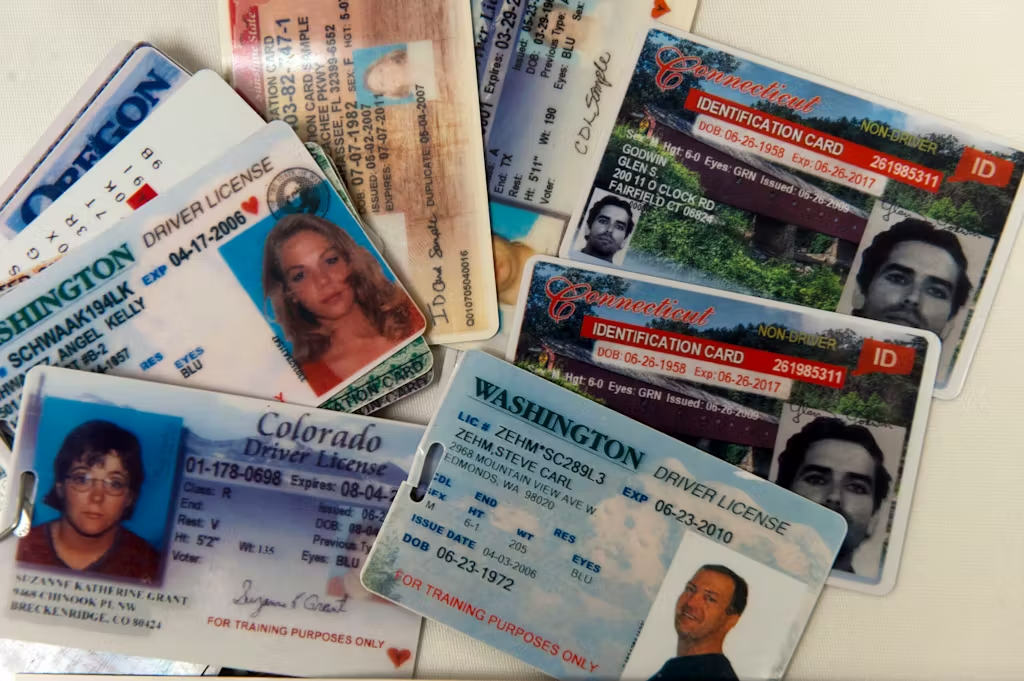
A stagnant account from a company on a load board can be a target for phishing. A bad actor might say, “Hey, this is Central Dispatch. We’re trying to get your updated information,” and then, once empowered, the scammer can pose as that company when targeting cars to steal. Once the scam is in motion, they’ll follow the double-brokering playbook by going to another dispatcher and actually getting a legitimate carrier to come pick up the car.
Loren Milbrath, also a senior investigator at Hagerty’s SIU, explains that these transactions are also subject to more explicit forms of conspiracy. “Maybe the bad actor who hired the carrier said, ‘Hey, when you pick up the car, tell the shipper that it’s going to Florida, but actually take it to another address in California. I’ll give you $10,000 when you drop it off, just don’t tell anyone.’”
To Catch a Thief…
To meet the surge in auto transport theft, police have stepped up enforcement efforts. So far, these moves are largely at the local and state levels. Theft rings keep appearing, but task forces in major cities, such as Los Angeles, have successfully broken some of them up.
In one recent Miami Beach, Florida case, in January 2025, local police arrested three men allegedly responsible for the theft of a Rolls-Royce Dawn, after the $300,000 hand-built luxury drop-top failed to reach its owner in Detroit. After looking into the matter, investigators “coordinated a controlled delivery” to catch the suspects in the act; they arrived at the designated location (in a Rolls-Royce Cullinan and a Bentley) and paid the driver $700 for delivery of a stolen orange Lamborghini Urus. Police told 7 News Miami that it wasn’t the group’s first offense, and that the thefts were being coordinated with Russian and Armenian brokers.

Milbrath, of Hagerty SIU, says he’s heard rumblings that thefts executed here in the U.S. are being enabled or even coordinated by third-party criminals located overseas. In exchange for a percentage of return, these string-pullers will sell the necessary information, access, or playbooks to local thieves.
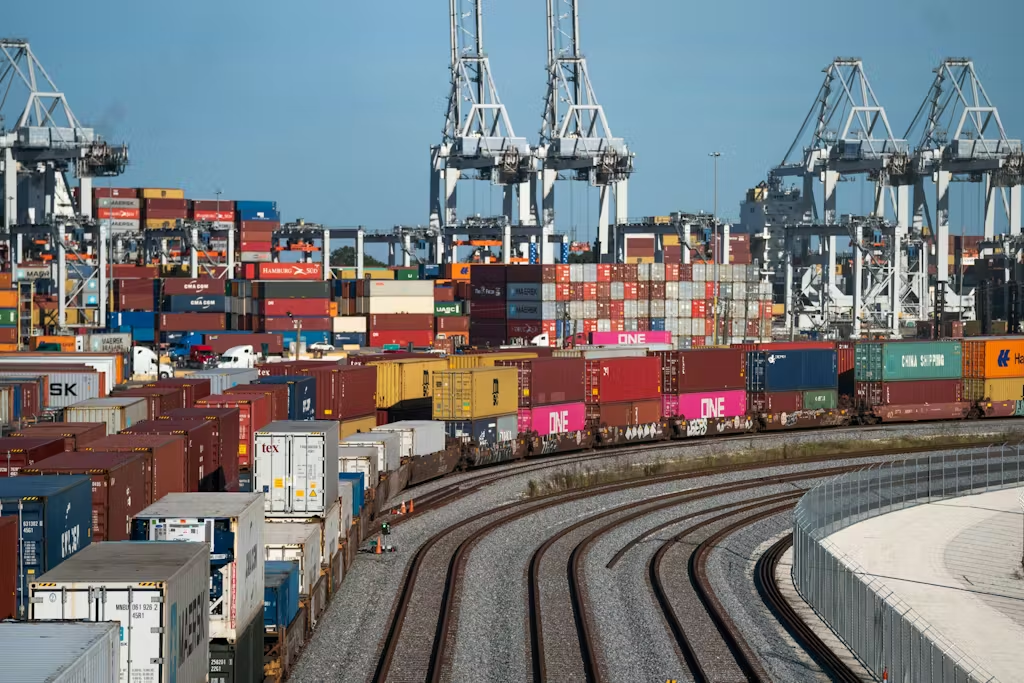
The U.S. Justice Department recently brought a case, in the Eastern District of Michigan, against eight men charged with conspiracy to transport stolen vehicles. The 12-count indictment explains that the men received stolen vehicles at as many as four commercial or industrial lots in the Detroit area. Many of these vehicles were allegedly procured through auto transport fraud, after which they reached one of these staging lots. Afterward, such vehicles would end up in shipping containers and from there be transported via rail, perhaps to a port city (Georgia’s Port of Savannah, most likely), to then be loaded onto a cargo ship.
“This indictment underscores the importance of law enforcement collaboration to ensure those who exploit our borders through unlawful commercial vehicle smuggling operations are brought to justice,” said Reuben Coleman, Acting Special Agent in Charge of the FBI Detroit Field Office. “The FBI in Michigan is proud to work alongside our local, state, and federal partners in disrupting both domestic and international trafficking networks. We remain committed to protecting our community and safeguarding the integrity of our infrastructure.”
Not all thefts are treated with the knowledge and specificity of these recent task forces. Many victims of such thefts have, understandably, called police to report their car stolen, explaining that they paid a broker for a service and now the car is gone. In these situations, however, police may well deem the situation a civil matter rather than officially declare the car stolen.
“The typical civil process requires sending letters, going to court, getting the carrier served, asking them to show up, and if they don’t, then at that point, now it’s a stolen car,” explains Milbrath. “By then, of course, the car’s long gone. Fortunately, a lot of law enforcement is getting increasingly proactive in bypassing that process as awareness of these crimes increases.”
In cases where a hidden tracker tips off the owner that something is amiss, the bad actor may then ask for additional funds to “release” the car—a delay tactic to prevent the vehicle from being reported stolen until the vehicle reaches its fraudulent destination. But, typically, once a car disappears through one of these schemes, the chances of recovering it are slim to none. Sometimes, according to Hagerty SIU, they’re re-VINned and resold. Other times, they end up in Mexico and are used by drug cartels. The Middle East is another common destination—Dubai in particular. And even if a stolen vehicle is recovered abroad, getting it back can be a deeply complicated and thorny enterprise.

Prevention
For their part, government organizations are actively combating these threats through a combination of infrastructure improvements and an awareness campaign. The Federal Motor Carrier Safety Administration (FMCSA) began rolling out a new USDOT registration system, Motus, that contains more robust fraud prevention via facial ID verification. FMCSA also advises on best practices for not selling or sharing USDOT or MC numbers. (Incentives to do so can apparently be compelling, ranging from a few hundred to even $30,000 depending on the longevity in service and the number of broker affiliations.)
Individual companies are also taking similar steps. As Automotive News reports, major brokers such as Montway Auto Transport now require two-factor authentication for all vehicle pickups. Central Dispatch offers a “Carrier Scorecard” to help inform customers about their carrier’s “capabilities and performance.” Other companies are using one-time QR codes and secure authenticators to confirm the identities of carriers, while others demand photos of the truck, its VIN, and the operator’s driver’s license.
These are all useful tools, but what matters is that brokers, carriers, and shippers actually use them. So here’s what you can do to minimize your risk and protect your precious car shipment from bad actors:
- Be suspicious of any deal that seems too good to be true.
- Select a broker or carrier that uses modern identity verification tools and GPS Tracking.
- Booking with a reputable full-service (direct) carrier. Outfits like Reliable Carriers own their own trucks and employ drivers, in addition to working with trusted owner-operators. Direct carriers are usually more expensive but add a layer of trust and remove middlemen from the equation. At some level, of course, any system can be hacked and compromised.
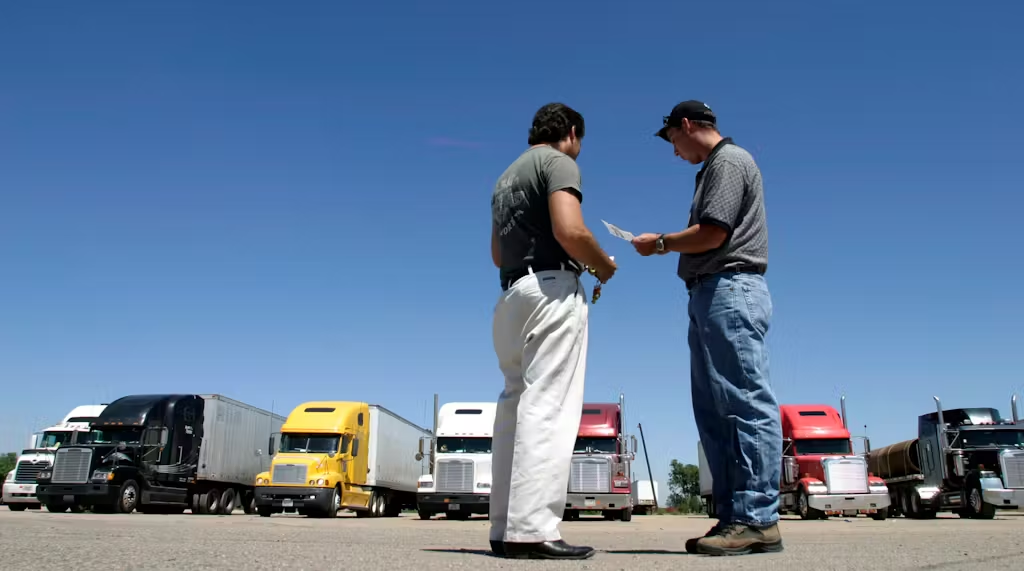
- Confirm the carrier’s driver’s license and truck number: To the best of your ability, make sure that all of this information lines up before allowing the keys to be handed off. “If it’s not the person that’s supposed to come to pick up the car, that’s the first red flag,” says Santos. “Or if you are contacted about your request by a broker you didn’t engage.”
- GPS tracking: Using whatever means at your disposal, multiple methods of GPS tracking will help you keep an eye on where your vehicle is going. If it’s scheduled to go from Oregon to Montana, but it’s making a detour headed toward Los Angeles, something may be up.
- Confirm the bill of lading: The bill of lading is a legally binding document between the shipper and the carrier. It is critical to verify that this document shows the correct destination address before the vehicle is released to the carrier.
A Fresh Approach?
In addition to the tools and tactics outlined above, some companies are also using a modified methodology that increases both trust and customer service. Auto Hauler Exchange (AHX), based in Rochester, Michigan, has been operating for about five years as a digital platform that directly connects shippers to carriers. Rather than operate as a broker that sets prices for both parties, AHX connects the two parties directly and collects a percentage fee (from the shipper) based on the carrier’s rate. On the company website, in massive letters, there is a banner that reads: BYE BYE BROKER.
“We are the UnBroker,” says AHX Chief Operating Officer Dana Randazzo. “Brokers don’t give shippers many details. We are about full transparency—on the rate, the communication, who your driver is, who your carrier is.

“Customers upload their vehicles, set their price, and then it’s marketed directly to the carriers. We use several vetting systems to monitor the carriers and from there it’s 24-7 monitoring of those carriers, of those direct drivers, of their insurance, of their DOTs. As soon as a carrier falls off on our point system for vetting—whether their COI [Certificate of Insurance] expired, whether they’ve sold their trucking company, whether they’ve had an email change with the FMCSA—they’re not allowed back onto our platform. And we’re just not looking at FMCSA for information. We have a third party that we use to vet the carriers. We’re looking at their authority, we’re looking at insurance, we’re looking at the driving record associated with that truck.”
AHX uses electronic log devices (ELDs) to monitor the truck’s position, while at the same time monitoring the driver’s position via an app on their phone. Doing so helps ensure that the driver and truck picking up the vehicle are both on plan. Another tool is that the precise details of the load—such as the VIN—are not available to the carrier until their ELD is detected within a certain radius of the pickup location.
The primary user base for AHX are dealers and OEMs who ship large numbers of vehicles on a regular basis. But after friends, family, and referrals from dealerships started bringing a lot of one-off shipments to its door, AHX launched a personally owned vehicle (POV) division it calls AHX Direct. The service, available to individuals, uses the same technology and enjoys all the same features as the commercial service.

“Customers are used to being told by a broker what the rate is,” says Randazzo. “Our idea is that the customer sets the rate, and we can give a general [guidance] of the market. Sometimes a listed vehicle will pick up [a carrier] really fast and we’ll tell the customer, ‘You might want to lower that rate.’ And throughout the whole process, we’re here. If the customer needs details, wants help—we’re happy to provide that as well. We’re a bit of the best of both worlds between a broker and load board.”
AHX is open about the fact that it could have a larger pool of carriers, but size isn’t the goal. “The best pool” is, in this case, more valuable than the biggest.
Be Vigilant
These new forms of fraud and transport theft may primarily target the high-end and exotic cars that most of us don’t deal with, but any auto shipment is vulnerable to some degree, and thefts of more ordinary cars do happen. Best practice is to take every possible precaution, do your due diligence, and ensure—as much as possible—that careful procedure is followed at the point of handoff. Of course, the best possible protection, and certainly the most fun, is to fly out to the car and drive it home yourself.
Report by Eric Weiner
find more news here.