No one had really doubted it, of course. Still, the Defender wants to prove itself once and for all – at the toughest off-road race in the world: the 2026 Dakar Rally.
The best part of it all? We were there for the test drives in Morocco.
And how!.
Lost. Two days in the Sahara. Practically no water. No sense of direction. Deadly heat by day, freezing cold by night. Thierry Sabine finds himself in a place as hostile to life as the surface of Mars – only without a spacesuit or mission control that he can contact. So yes, Sabine has a serious problem when he gets lost on his motorbike during the 1977 Abidjan–Nice Rally. No way to call out, “Houston, we have a problem.” He’s on his own. We imagine he does what any reasonable adventurer would do in that situation: he takes a moment to enjoy the breathtaking beauty of the North African landscape.
As it happens, he gets lucky. He’s found and makes it back to France alive. One might expect this kind of experience to lead to a spiritual awakening and that he would spend the rest of his life wandering the earth as an itinerant preacher. But Sabine, an advertising executive by trade, ticks differently: “If life gets boring, risk it.” That’s the lesson he takes home and makes his own. So he creates a rally that gives participants a real chance to “break out from the fog of everyday trivialities and set sail for new shores”, as French magazine Le Point poetically puts it when the first Paris–Dakar Rally kicks off in 1978.
The rally itself is more like raw prose – a story of sweat, sand and engines. Its brutality toward man and machine quickly earns it a reputation as the ultimate adventure. That hasn’t changed much to this day, despite all the professionalization and high-tech navigation. “You can’t win the Dakar – you can only not lose” is a popular saying and unofficial motto among the competitors. On the motorsport madness scale, only the Isle of Man Tourist Trophy ranks higher. Otherwise, you have to leave the realm of motorsport entirely – and you end up with things like climbing Mount Everest.
It’s all or nothing here. That’s why manufacturers use the Dakar as the ultimate test of their vehicles’ strength. The usual suspects – Nissan, Toyota, Land Rover – prove their worth early on. But Porsche also discovers unexpected off-road potential in its sports cars. And yes, even a Rolls-Royce once competed – though that idea was born in a pub. Remember? If life gets boring . . .
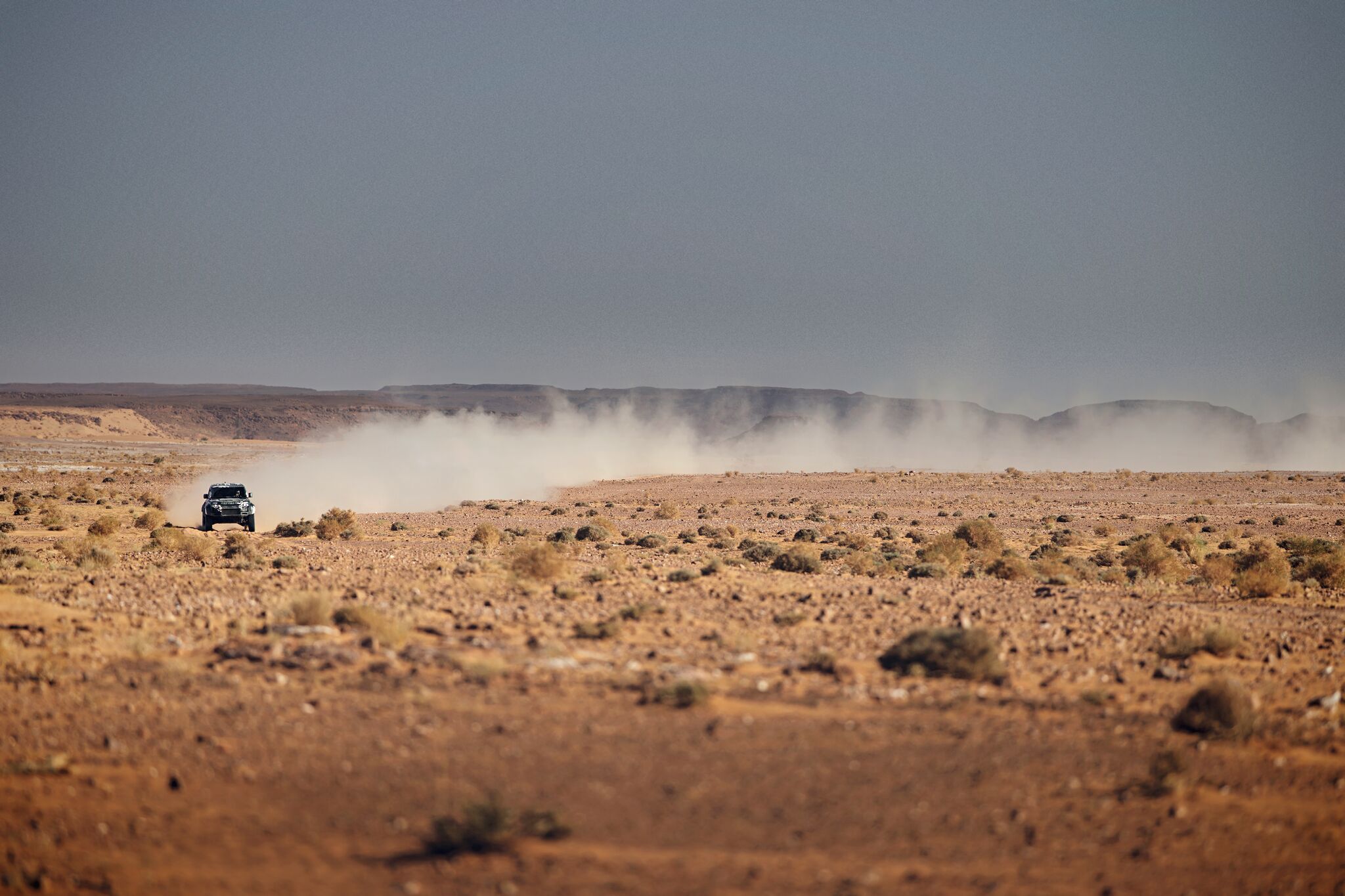
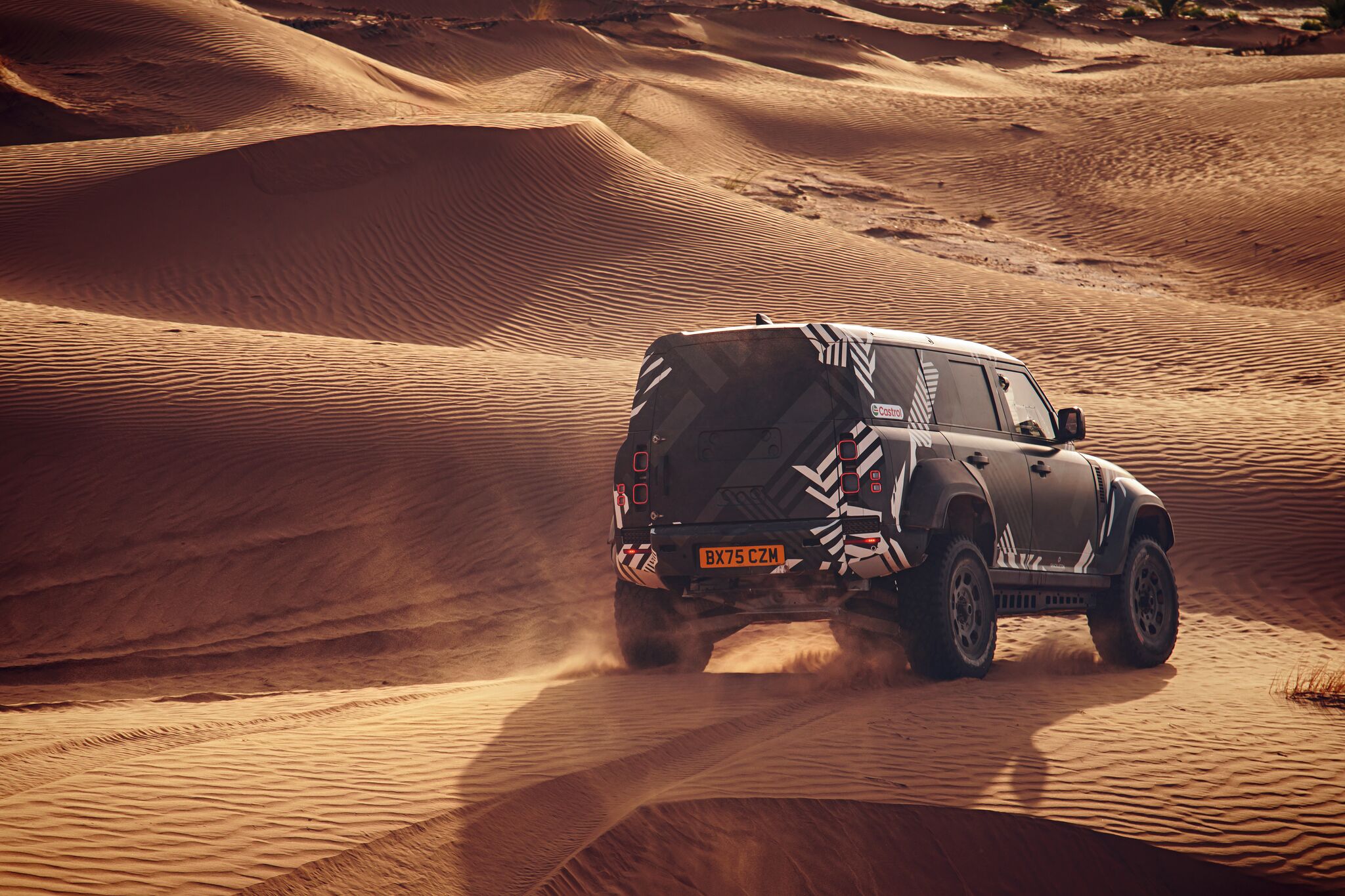
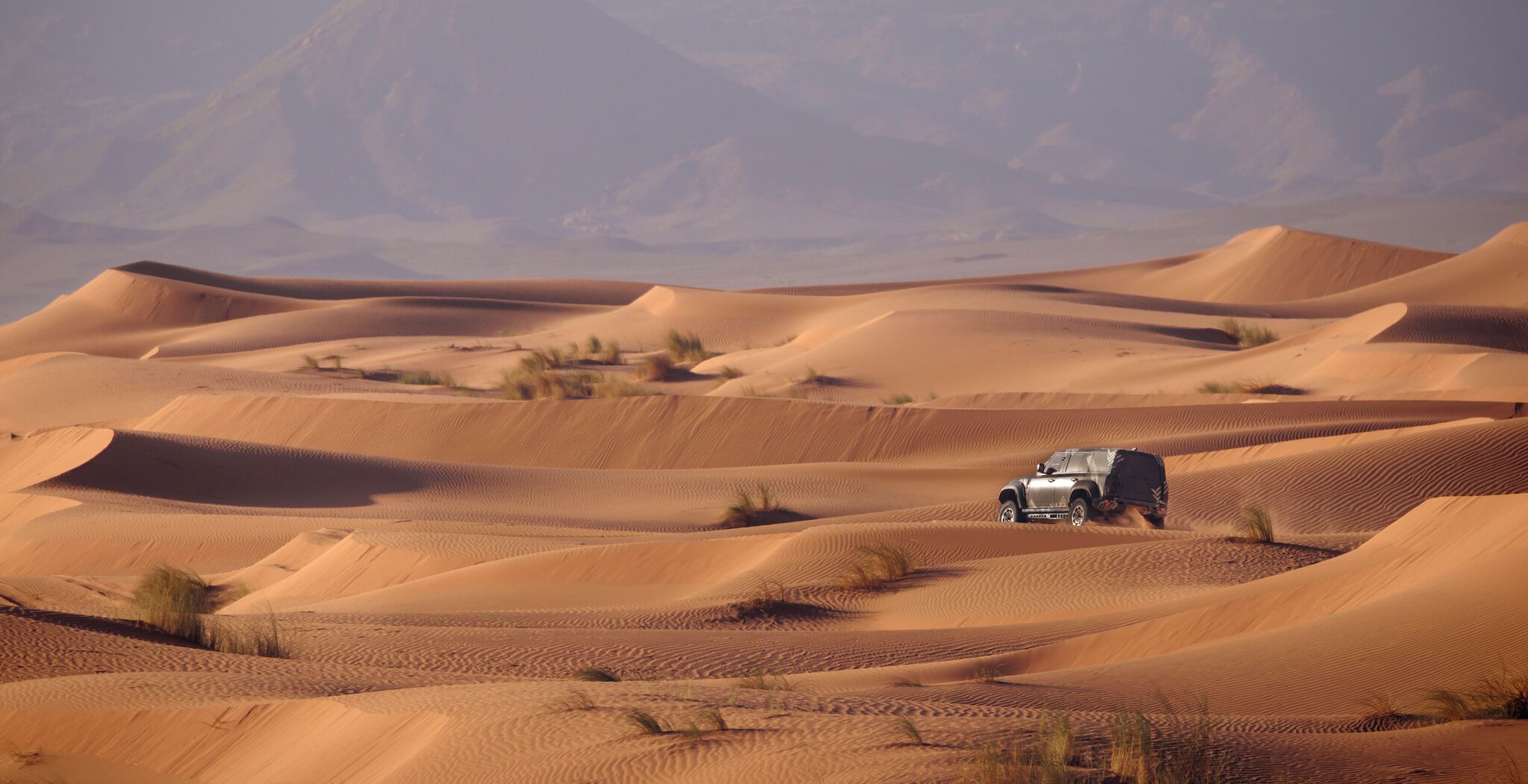
Morocco, September 2025. Just for context: no one ever mocked the Defender for losing its rugged edge or turning into some hip boulevard cruiser. That’s not how it was at all. Still, here we are, in the middle of nowhere, about an hour from Morocco’s Errachidia Airport. Roughly three months to go before the start of the Dakar. The air is hot and dry. Sand, stones, dust, camel grass. We’re driving into the desert with a handful of production Land Rover Defenders, on tracks used for Dakar testing – across sand dunes and over brutally rough terrain. The production cars take it all in stride. Behind the wheel, you mostly just enjoy the view.
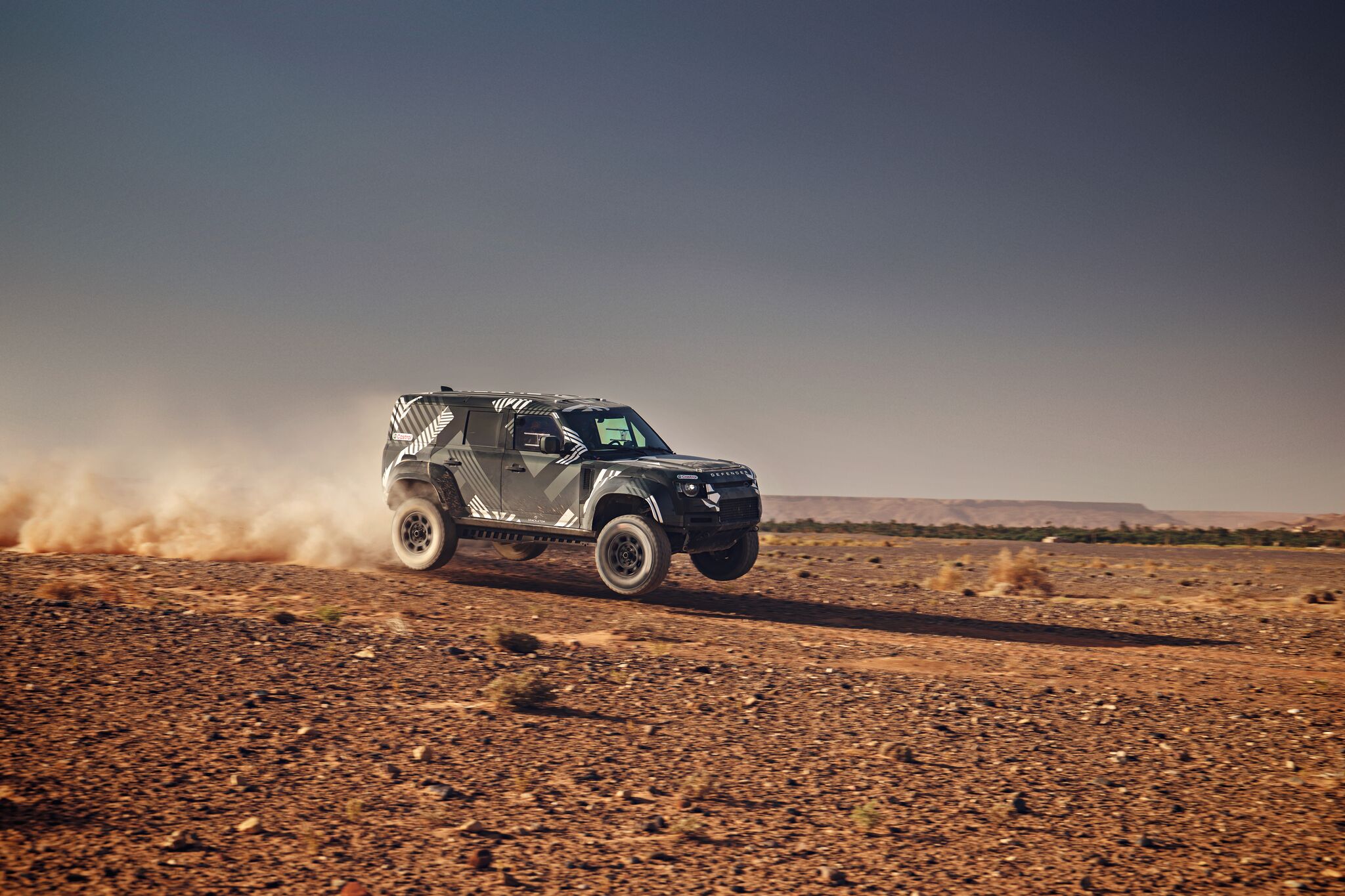
A little later, in the distance at the foot of a mountain range, a long plume of dust appears, led by a tiny, fast-moving dot. The dot comes closer. It grows larger. Then it takes off – literally – flying some 30 meters through the air before landing and charging on. And there it is: the unmistakable front end of a Defender. Then it stops. A woman steps out. Dark hair, green-blue eyes, blue-painted nails, California smile, dust-streaked racing suit. Her name: Sara Price. The 32-year-old isn’t some random desert wanderer but one of the most versatile off-road racers of her generation. She’s been riding two-wheelers since she was eight, holds 17 national motocross titles, an X Games medal, and was the first woman in Kawasaki’s factory team. Later came Extreme E, Stadium Super Trucks, Trophy Trucks – and the 2024 Dakar, where she became the first American woman ever to win a stage. She greets us with a cheerful “Hey, how are you?” as if this were some upbeat cocktail reception.
Then she gives us a tour of her machine. The Defender has been modified: 17-inch wheels with chunky 35-inch tires, wider track, more ground clearance, motorsport-grade steering rack, lightweight exhaust. Under the hood: the 4.4-liter twin-turbo V8 from the Defender OCTA – which, to qualify as a homologated production model, must be built at least a thousand times. Strict race rules. Mark Cameron, managing director at Land Rover, comments drily: “We’ve already sold 3,000.”
One of the most significant and most important changes compared to the production version, Price explains, is the fuel tank. It holds 500 liters – enough for the insanely long stages stretching hundreds of kilometers. A stock Defender with its 635 hp and an official combined fuel consumption of 13.8 liters per 100 km could theoretically travel more than 3,600 kilometers on that. Meaning that if you filled up here in the Sahara, you could drive straight to Hamburg without stopping.
Price is entering the revived stock class for production-based vehicles. Land Rover will field three Defenders – one piloted by Sara Price, another by rising star Rokas Baciuška, and a third by Stéphane Peterhansel. Calling Peterhansel a legend would be an understatement: the Frenchman holds a record 14 Dakar victories – six on bikes and eight in cars.
In January 2026, the Dakar Rally will run for its 48th edition. Around 8,000 kilometers await the teams, with 5,000 of those kilometers laid out as timed stages. It all starts on the shores of the Red Sea in Yanbu, looping across Saudi Arabia and back again, with a rest day in the capital of Riyadh. Four stages, two brutal marathon “refuge” stages – just sleeping bag, tent and rations for the drivers, no outside help. Classic Dakar. The participants know the drill. Though things were a bit different at the beginning. When Freddy Kottulinsky drove – and won – the second Paris–Dakar in 1980, he had packed only a few pairs of shorts and a couple of T-shirts. “No one told me I should bring a tent and sleeping bag. So I had to sleep in the Iltis, stretched across the front seats. To make matters worse, I’d only brought summer clothes. I thought a desert rally would be hot all the time. I didn’t realize the temperatures drop below zero at night,” he told German news magazine Der Spiegel years later. He never raced the Dakar again, despite lucrative offers. The only woman ever to win the Dakar so far is Germany’s Jutta Kleinschmidt, who took the title in 2001.
But not every story ends as a lighthearted campfire tale. More than sixty people have lost their lives in the Dakar – drivers, co-drivers, mechanics, journalists. Among them Thierry Sabine himself. In 1986, while searching for missing competitors, his helicopter crashed into a mountain during a sandstorm. His ashes were scattered a few days later in the Ténéré, at the Arbre Perdu – the Lost Tree, a lonely acacia in the middle of the Sahara, now known as the Arbre Thierry Sabine. A crooked skeleton of a tree, with a small plaque in front of it bearing his name, birth and death dates. It’s said there once was another inscription there – his life motto: “For those who go, a challenge – for those who stay (home), a dream.”
Text Matthias Mederer| Photos Nick Dimbleby / Land Rover
ramp #69 More Than Machines
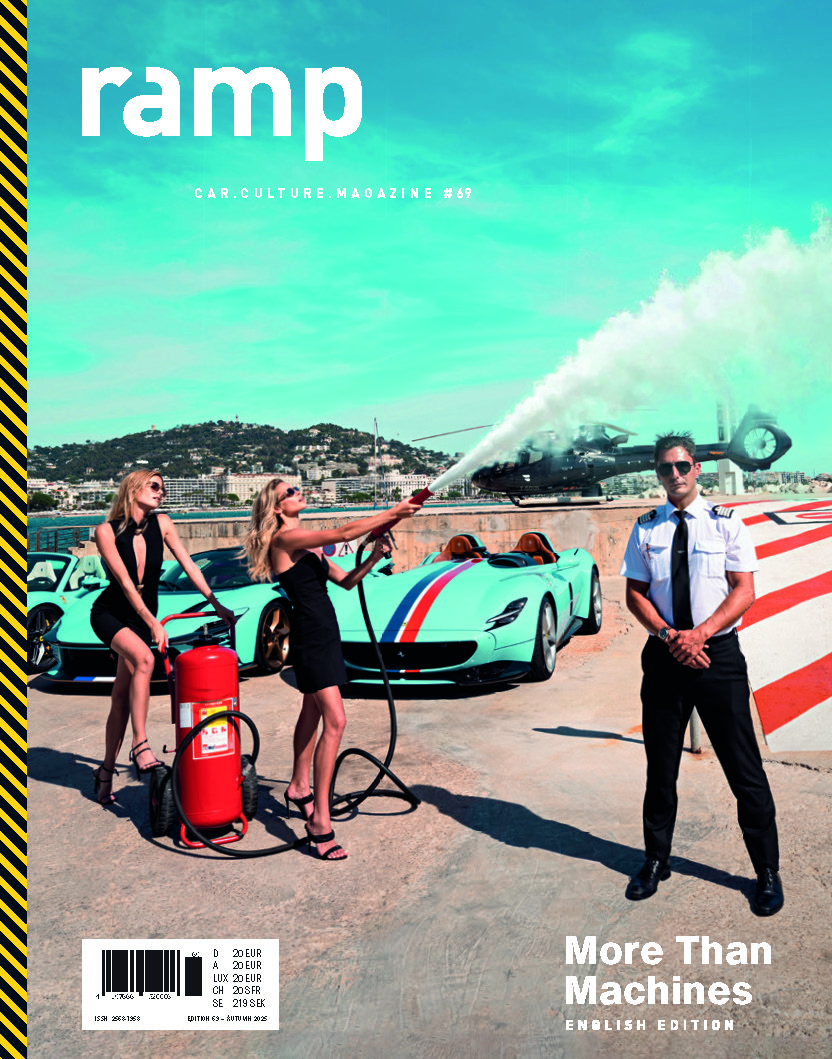
Maybe it all starts with a misunderstanding. The mistaken belief that humans are rational beings. That we make decisions with cool heads and functional thinking, weighing and optimizing as we go. And yes, maybe sometimes we do. But only sometimes. Because in truth, we are not reason, we are resonance.
And so this issue of ramp is a cheerful plea. For beauty that needs no justification. Find out more