We’re at the Mazda Europe Design Center north of Frankfurt am Main, washing a Mazda6e – together with
Jo Stenuit, Design Director Europe. The talk turns to clarity in design, the luxury of simple choices – and the insight that eight colors are plenty for a car.
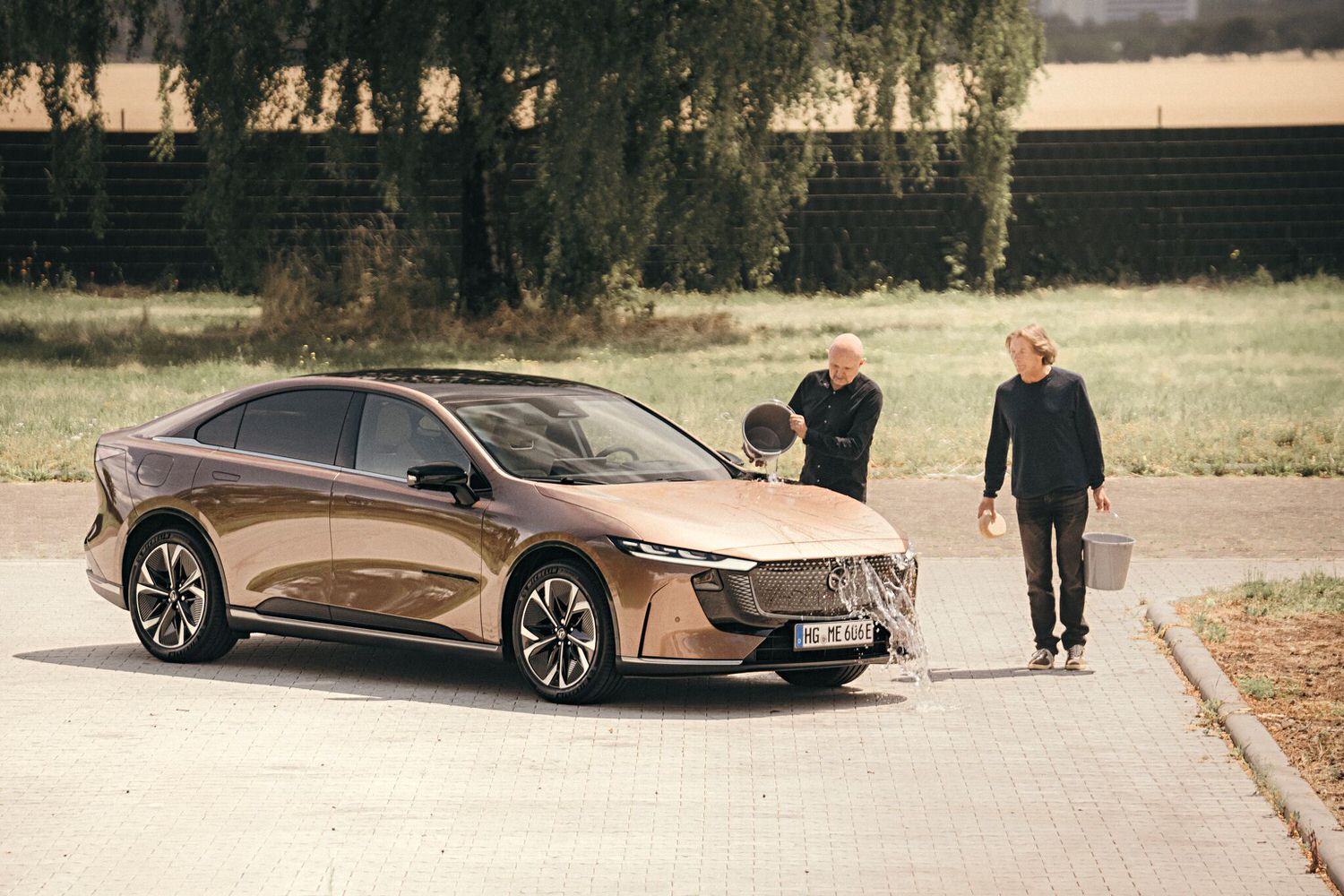
In Oberursel, a few kilometers outside Frankfurt, it’s pleasantly quiet. Behind red brick façades lies the Mazda Europe Design Center – almost like a campus, shielded from the city’s bustle visible on the horizon. It’s a place where ideas about lines, proportions and surfaces are given space to mature. Birds chirp, leaves rustle, clouds drift across the sky and cast moving shadows over the courtyard. Sunlight glances off the crisp curve of a fender, a cloud swallows the gleam along the hood. And then: a bucket of water, two sponges. Next to the Mazda6e, the brand’s first all-electric midsize sedan, stands Jo Stenuit, Design Director Mazda Motor Europe. The ramp car wash can begin.
Mr. Stenuit, Mazda never seems to chase trends. Is that true?
Absolutely. Our Kodo design philosophy – “Soul of Motion” – has informed our work for the past fifteen years. It’s not a fleeting trend but an attitude. Kodo means that every car has a soul, that it radiates motion even when it’s standing still. Our designers and clay modelers quite literally put their soul into every model. You can feel that immediately.
That sounds pretty spiritual for a car we’re pouring water over.
Yes – but that’s what it’s all about. When you open the door, the car shouldn’t bombard you with displays and effects. It should welcome you. Calm instead of sensory overload. A feeling like the unity of horse and rider – connected but never overwhelmed – what the Japanese call jinba ittai.

So the Mazda6e is all about deliberate reduction?
Exactly. Fewer buttons, clearer interfaces, intuitive operation. Though “intuitive” means something slightly different in Japan than in Europe. We spent a long time working on that to make sure it works for everyone.
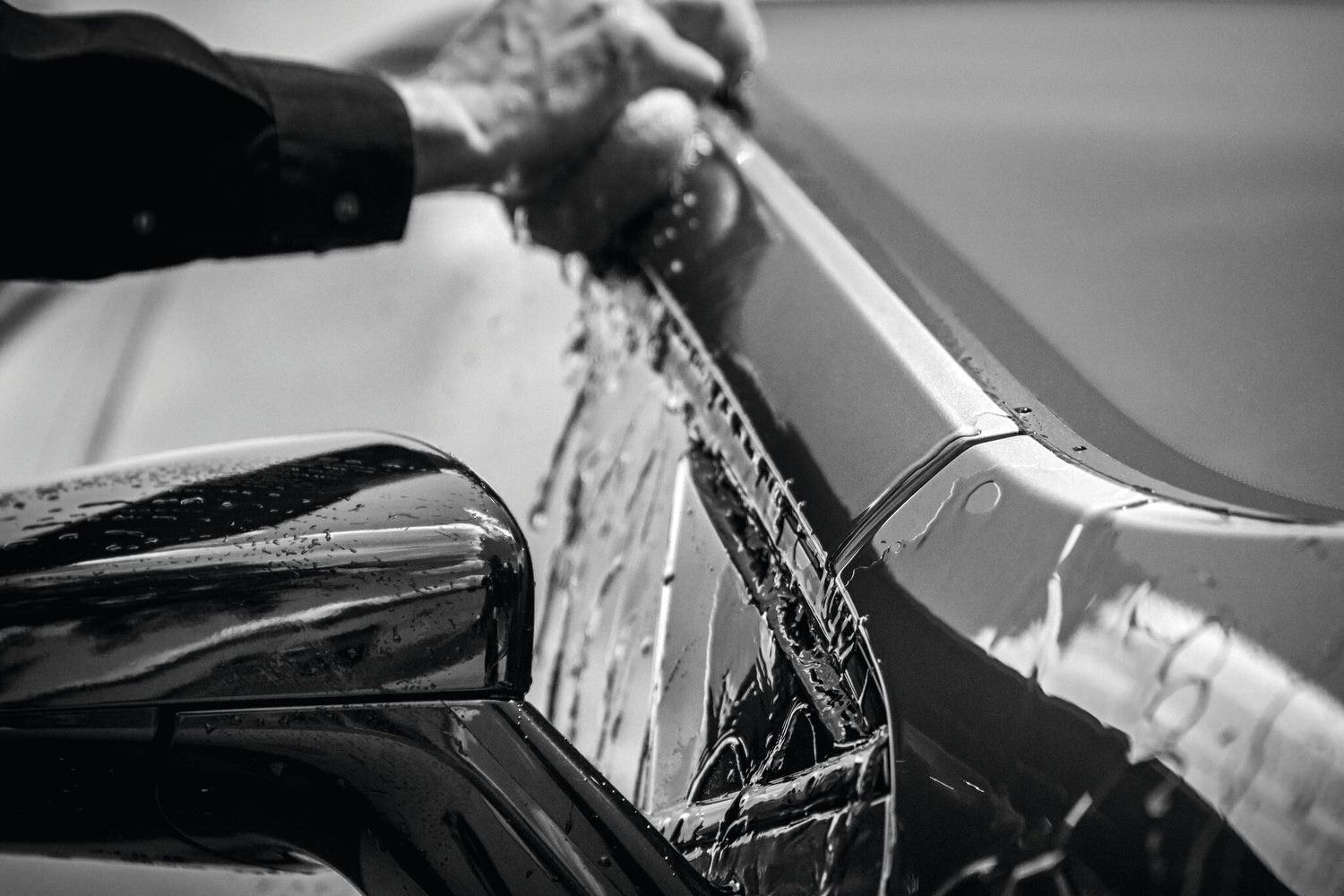
Running the sponge over the body, you notice the lines aren’t just there for the eye.
That’s exactly the point. We sculpt in clay, we shape surfaces with our hands. A car shouldn’t just look good in a digital rendering on some screen – it has to play with light, have depth in shadow, and yes, you need to be able to feel it. Washing actually reveals the tension in the surfaces even better.
A car wash as the ultimate design check?
[Laughs] In a way, yes. When your hand glides over a surface and it feels right, then we’ve done our job well. Good design isn’t just visual – it speaks to all the senses: seeing, touch, even hearing when you close the door.
Mazda came to electrification rather late. Why?
We were cautious. Mazda is small compared to other manufacturers, which means we have to take different paths. We build about 1.2 million cars a year worldwide – that’s one-tenth of what Toyota or VW produce. Our strength is focus. No fifty derivatives, just a clear program. The Mazda MX-30 was our first step, an experiment: how would customers react, and how could we blend our design DNA with an electric drivetrain? With the Mazda6e, we’re taking the next step.
What sets it apart from competitors?
On the technical side, we offer two battery concepts – LFP for customers focused on value for money, and NMC for range. The fact that the long-range version has a lower charging rate is intentional. We wanted to keep weight and thermal stability under control instead of dazzling with big numbers. Design-wise, we’ve kept the flowing surfaces that have defined Mazda for years, combining them with sharper lines, a modern light signature, and a clean front graphic. That’s Mazda’s future: familiar yet evolved.
You mentioned sensory overload earlier. How do you counter that?
We want technology to support, not dominate. Digital, yes – but focused. Clear information, no clutter. The driving experience always comes first.
Sportiness plays a role too, right?
Absolutely. But Mazda’s sportiness isn’t aggressive. It’s about precision – direct steering, agility, control. The MX-5 is our best example: light, affordable, pure. If we stuffed a heavy electric drivetrain into it, it wouldn’t be an MX-5 anymore. Sportiness has to stay authentic.
And customization? Everyone wants tailor-made these days.
We believe in “simplified choice”. No endless configurator lists where you forget what you picked ten pages earlier. We pre-filter, offer sensible packages, and a few but great colors. It makes the process easier – more like Apple, less like a PC maker with three hundred options.
And this color here . . .
. . . is a beautiful brown tone called Melting Copper. The craftsmanship jumps out at you. We don’t need twenty-five paint finishes – seven or eight good ones are plenty.
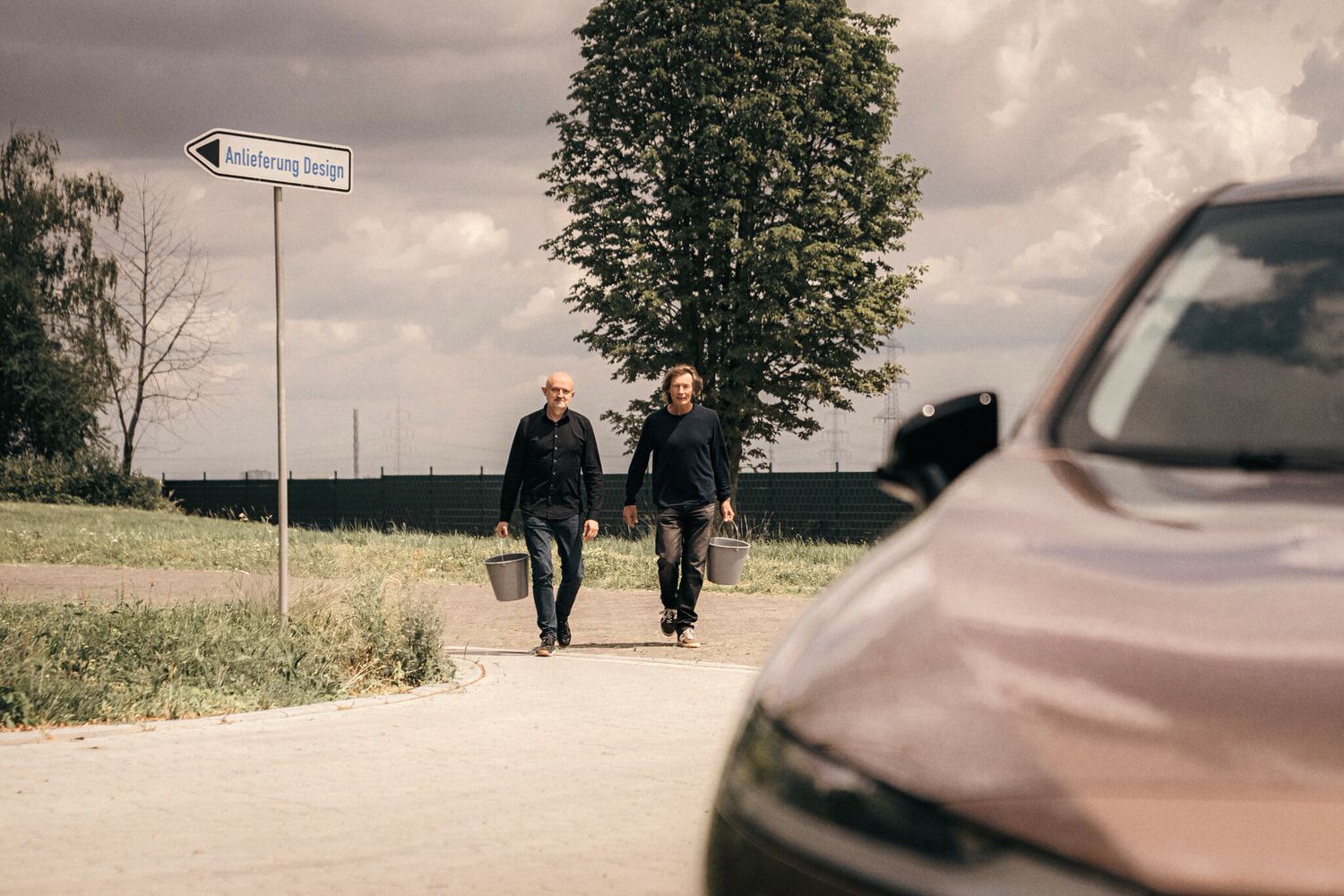
Jo Stenuit speaks calmly, pausing to think before he answers. Throughout our conversation he keeps reaching for the sponge, running it deliberately over the Mazda6e’s paintwork, as if to retrace its lines with his hands. Every curve, every edge gets his attention – the choreography, you could say, develops a rhythm of its own. Speaking of rhythm . . .
Music in the car – a personal thing for you?
Very much so. I love music. And sound quality completes the driving experience. Especially in electric cars, which are naturally quieter, good sound matters. Even our base system is strong. A bad sound system in a car? That’s a no-go for me today.
The trunk, with 466 liters, is quite roomy.
True, but we also wanted to give passengers more space. A generous cabin, long seat cushions, ample leg and headroom. Plus an extra 72-liter front compartment for charging cables or a small backpack. And for those needing more cargo space, we still have our SUVs.
And the interior?
We wanted to take Mazda interiors to a new level. Sustainable materials reminiscent of suede, a 14.6-inch touchscreen that doesn’t dominate, wireless charging, a Sony sound system – and a glass roof as standard. It all fits our philosophy: calm, reduction, comfort.
Sounds pretty luxurious.
Yes, we’re positioning ourselves deliberately just below the traditional premium brands. In Germany, the entry-level Mazda6e starts below €45,000 – not a bargain, but a lot of substance for the money. Mazda isn’t meant to be a mass producer, but a brand with character.
You talk a lot about soul and calm. Isn’t that risky in a world obsessed with spectacle?
Maybe. But we believe that at some point, people get tired of overstimulation. Then they’ll want a car that’s clear, beautiful, honest. And that’s exactly where we come in.
Jo Stenuit was born on October 30, 1968, in Belgium. He earned his bachelor’s degree in product design from Artesis University College of Antwerp in 1993, followed by a master’s degree from the Royal College of Art in London in 1995. After stints at Opel and Volvo Cars, he joined Mazda in 1998, taking on various roles. In November 2018 Stenuit was appointed Design Director at Mazda Motor Europe in Oberursel near Frankfurt.
Mazda 6e Takumi
- Powertrain electric motor
- Power 258 hp (190 kW)
- Torque 320 Nm
- Weight 2,027 kg
- 0–100 km / h 7.6 s
- Top speed 175 km/h
- Battery capacity 68.8 kWh
Text: Michael Köckritz
Photos: Matthias Mederer · ramp.pictures
ramp #69 More Than Machines
Maybe it all starts with a misunderstanding. The mistaken belief that humans are rational beings. That we make decisions with cool heads and functional thinking, weighing and optimizing as we go. And yes, maybe sometimes we do. But only sometimes. Because in truth, we are not reason, we are resonance.
And so this issue of ramp is a cheerful plea. For beauty that needs no justification. Find out more