There have been some big automotive anniversaries in 2026. This year marks 100 years of Pontiac. The Interstate Highway System celebrates its 70th birthday. The Lamborghini Miura celebrates its 60th. The Lotus Esprit turns 50, and the Lotus Elise turns 30. The Porsche Boxster turns 30, too, and so does the Dodge Viper GTS.
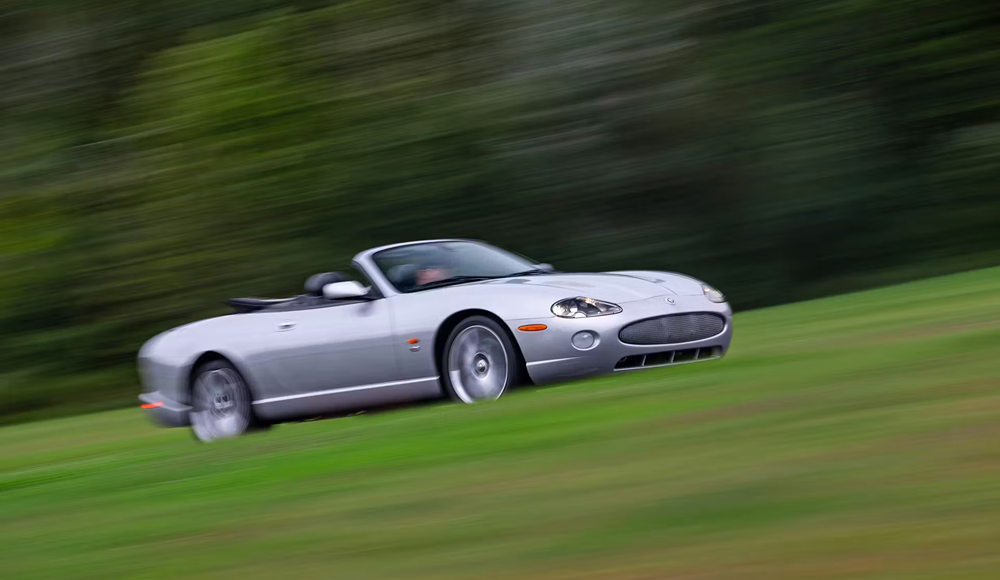
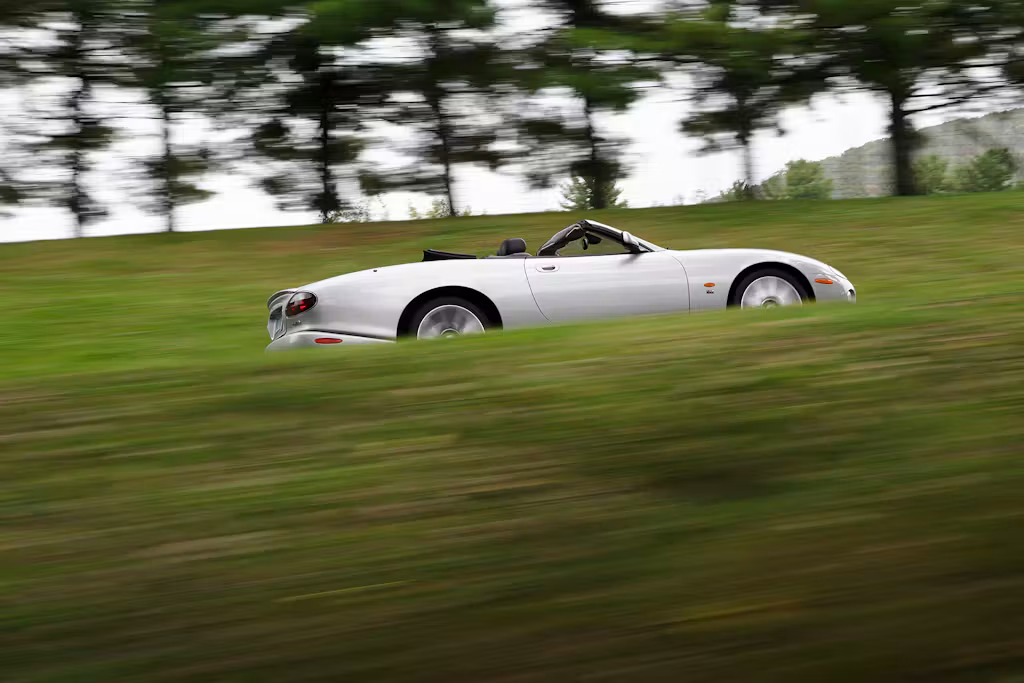
Somewhat lost in all these big birthdays is another 30th anniversary—the Jaguar XK8. Maybe it’s the tumultuous current state of the Jaguar brand, but whatever it is, it can be easy to forget about the XK8 and the supercharged XKR in the large crop of modern collector cars.
Available in either curvy convertible or even curvier coupe form, the XK8/XKR was nevertheless an important model for the company with the cat on its badge. It injected a fresh, Ford-funded dose of verve into Jaguar when the company needed it most, even if that excitement didn’t last forever.
Today, XK8s and XKRs offer V-8, rear-drive cruising, as well as good looks and pleasing proportions that are aging well. They’re not that expensive relative to other European performance cars of the same age, either, although they do still come with European performance-car maintenance.
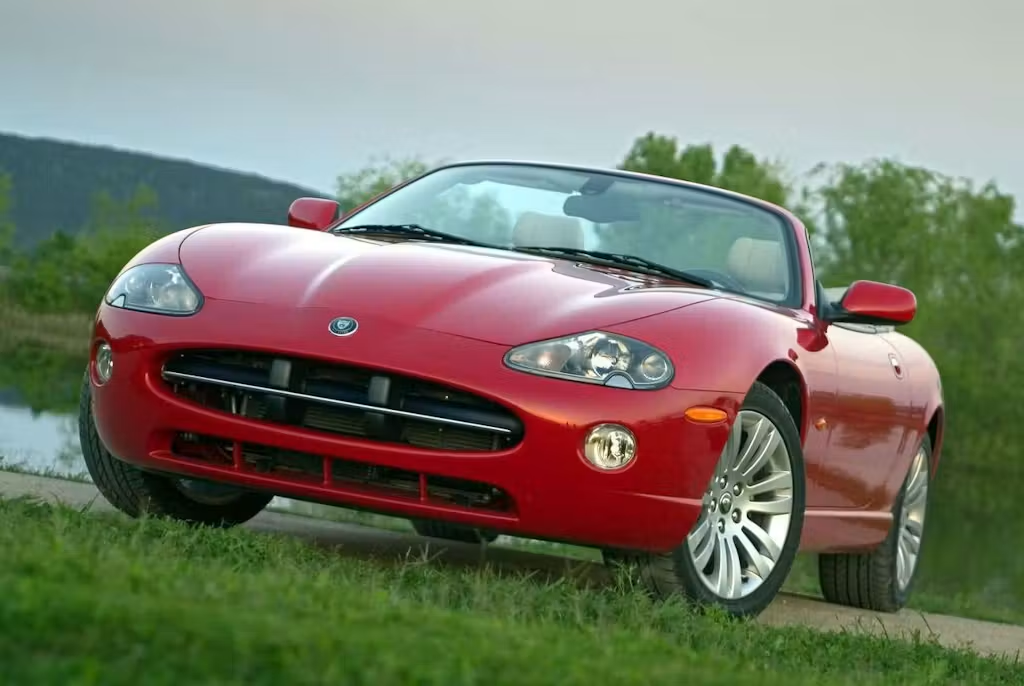
By the late 1980s, Jaguar had weathered the breakup of British Leyland and was operating as an independent company again, albeit with an aging model range. Then, in late 1989, Ford swooped in, bought the whole operation for roughly $2.5B, and began freshening things up at Browns Lane.
The American buyout brought an injection of capital, updates to assembly lines, and new models. Among the first and most badly needed was a replacement for the XJS, which was on the market for nearly two decades with few major changes and certainly on the last of its nine lives. Internally known as X100, Jaguar’s new sporting model was planned around an all-new engine, called the AJ-V8, which was only the fourth all-new powerplant in the company’s history and boasted an aluminum block and heads as well as dual overhead camshafts.

By loading the video, you agree to YouTube's privacy policy.
Learn more
The new XK8 that came out in 1996 still used the floorpan of the ancient XJS, but with new underpinnings and a low, muscular body with a clearly E-Type-esque face. The new, Ford-funded V-8 initially came in a 4.0-liter displacement, rated at 290 horsepower and 284 lb-ft. The only available gearbox was a ZF five-speed automatic, hinting that this new Jag was more grand tourer than sports car, along with an up to 4000-pound curb weight and heavily boosted power steering.
Prices started at around $63K for a Coupe and $70K for a convertible. Not cheap, but you got real wood trim, leather, power everything, and a sophisticated engine, wrapped up in the most exciting new Jaguar in recent memory. Motor Trend described the new Jag as a “hedonistic motoring experience,” and described its demeanor as “both muscular and especially well refined.” An XK8 Convertible was also one of the famous Neiman Marcus Christmas cars in 1996.
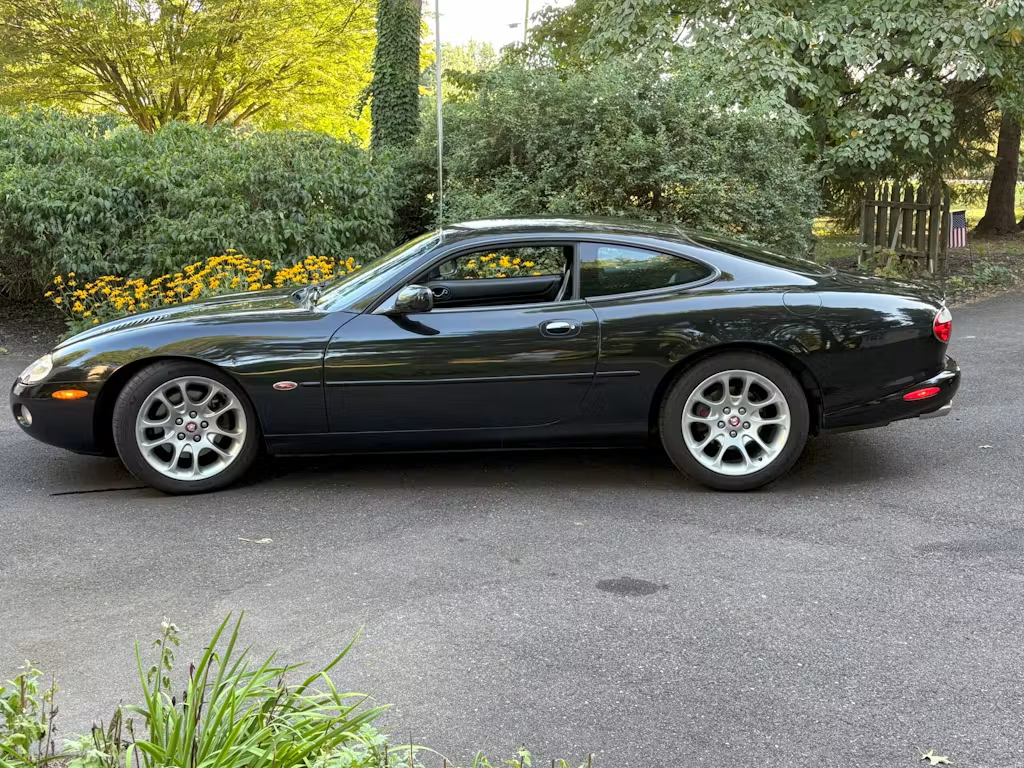
In 1998 (though it didn’t come to the U.S. until 2000), the platform got sharper claws with the XKR. Largely similar at first glance to the XK8 but with a mesh grille and two oval-shaped louvers on the hood, it came with extra thrust thanks to an Eaton M112 twin-intercooled supercharger. With 370 hp and 387 lb-ft, zero-to-60 in the low-five-second range was possible. Jaguar also gave the XKR a Computer Active Technology Suspension (or CATS, for short), its version of an adaptive suspension system. Car and Driver called it “provocative, confident, not at all trashy, with an upper-class British accent.” A green, machine gun-firing, missile-launching XKR convertible starred as the bad guy’s car opposite James Bond’s Aston Martin Vanquish in 2002’s Die Another Day, a film that also featured Halle Berry in a coral-colored Thunderbird. All just happened to be Ford-owned products.
At about $80K for the coupe and $85K for the convertible, the XKR was still comfortably less than a six-figure Mercedes SL600 that offered similar performance. Speaking of Mercedes, Jaguar borrowed a five-speed auto from the Germans for use in the XKR. For 2003, both XK8 and XKR got a stroked, 4.2-liter version of the SJ-V8, and both now shifted via a ZF six-speed auto. The 4.2-liter XK8 boasted 294 hp/303 lb-ft, while the XKR managed 390 hp/399 lb-ft. The XK8/XKR twins then soldiered on until 2006, when they were replaced by a second-generation version. Over the course of a decade, Jaguar sold over 90,000 XK8s/XKRs. Convertibles outnumbered coupes by about two to one, and a little more than a quarter were XKRs.
In the 30 years since the XK8 came out and the 20 years since it departed showrooms, prices for it and its racier XKR sibling predictably depreciated, but haven’t done a whole lot in recent years. Thinking its combination of low price, good looks, and blown V-8 soundtrack was prime to attract a new audience and bump prices, we put the XKR on our 2024 Bull Market list. But prices aren’t much different from where they were when that article went live in late 2023.
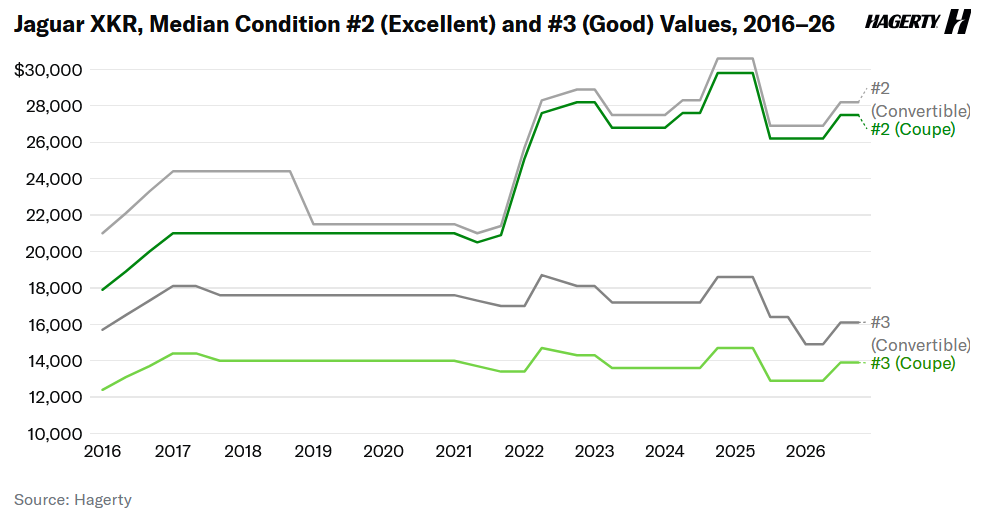
An early, 4.0-liter Coupe from 2000 is currently worth $26,500 in #2 (excellent) condition in our price guide. A convertible, despite being more common, commands a slight open-air premium at $27,100. The 2003 and later, 4.2-liter models in #2 condition are currently worth $27,500 for a coupe and $28,200 for a convertible. We don’t currently price the lower-spec XK8 in our price guide, but asking prices rarely stretch past the teens and there are plenty of XK8s out there changing hands for four figures.
And even though these muscular cats shared the road with millennial favorites like the Acura NSX and E46 M3, their core audience is the older folks who bought them new. As measured by Hagerty insurance quote data, nearly two-thirds of buyer interest for these cars comes from baby boomers or older, even though this cohort makes up less than 40% of the market as a whole. Barely a tenth of interest comes from millennials and younger, who make up over a fifth of the market as a whole.
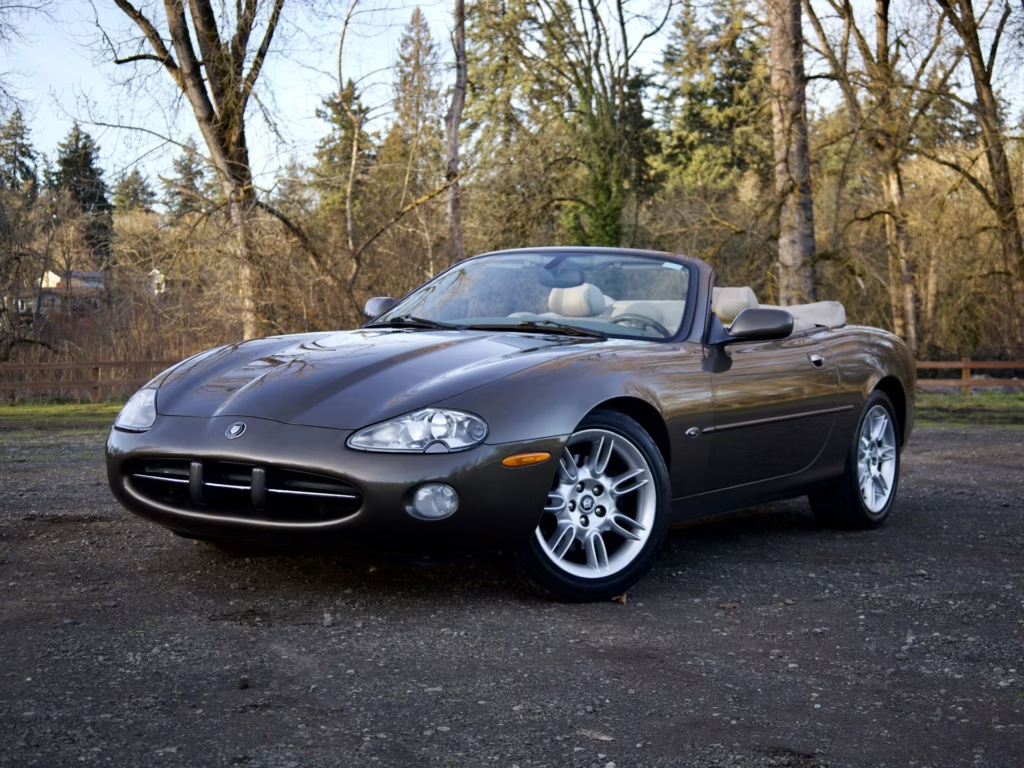
These cars have aged very well in this writer’s opinion, particularly the coupe, but when it comes to living with them, they are, well… Jaguars. Maybe the most major issue to look out for is in the engines of earlier cars, in which Jaguar used cylinder bores coated in Nikasil, which reacted poorly with the high sulfur content in U.S. gasoline at the time and resulted in premature engine wear. Jaguar replaced some engines under warranty and had switched to improved liners by 2000.
Early timing chain tensioners were also made of plastic, which of course degrades over time, but metal tensioners came in 2002. The power top system on convertibles, which operates via hydraulic fluid, is another common failure. Interiors also show age on higher-mileage cars or ones that have seen lots of sun, though they came in cool colors like oatmeal, cream, and even teal. There are technically back seats; they’re just more usable for stowing stuff than stowing people.
If you want a cheap-ish, good-looking, rear-drive V-8 two-door, there is a nearly endless supply of Mustangs, Camaros, Firebirds, Corvettes out there that would make more practical and financial sense. And of course there’s the Mercedes SL, too. If you want something a little different and a little more sophisticated, though, the Jag is still an affordable option and looks set to stay that way.
Report by Andrew Newton
find more news here.