In 1960 the Formula One World Championship celebrated its tenth anniversary; it was also the year that witnessed the final victory for a traditional front-engined grand prix car due to the arrival of smaller, lighter mid-engined cars with monocoque chassis instead of tubular spaceframes. It was appropriate that this was achieved by Ferrari, a team that had competed in the championship since its inauguration and its Ferrari Dino 246/60, with its stylish Fantuzzi-designed bodywork, represented the ultimate development of the front-engined grand prix car.
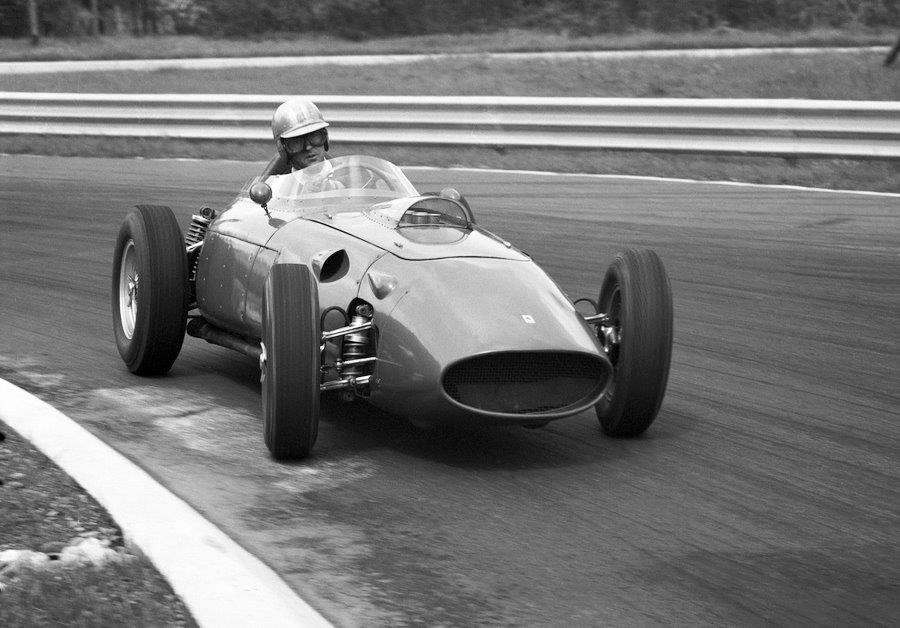
The ‘246’ was introduced in 1958, powered by a 2.4-litre quad-cam V6 engine, and took Mike Hawthorn to victory in the World Drivers Championship, the first British driver to win the title. The 1960 season saw Ferrari adopt Dunlop disc brakes and tyres while the engine installation, originally at a slight angle, was reversed along with the transaxle gearboxes that resulted in a reverse gear selection layout located on the opposite side of the cockpit. The time-honoured deDion suspension was finally replaced by an all-independent coilspring-and-wishbone arrangement. For the first race of the 1960 season, Ferrari sent three Dino 246’s to the Argentine grand prix for works drivers Phil Hill, Count Wolfgang von Trips and Cliff Allison, the latter two finishing fifth and second respectively. It was not until the fifth grand prix of the season, at Spa, that the power of the Ferrari engine could be exploited and Phil Hill qualified on the front row although assorted minor problems saw him finish in fourth place but at the Italian grand prix at Monza he finally secured a victory that the record books record as the final win for a front-engined grand prix car. However, it was achieved against an entry list made up of Formula 2 cars as the dominant British entries stayed away in protest at the dangerous condition of the concrete Monza banking. The photograph shows Wolfgang von Trips in his 246 Dino in action during a test session at Monza in 1960, seemingly driving it to the limit despite the fact that the rear bodywork has been removed.
Photocredit: McKlein Archive