At the beginning of the twentieth century, the automobile was in the ascendancy. During the first decade the ‘horseless carriage’ carried over elements of earlier horse-drawn carriages, not least the use of wooden artillery wheels, but were now powered by combustion engines that offered numerous advantages not least of which was higher speed. Inevitably this appealed to those of an adventurous nature who were able to experience the thrill of travelling at previously unimaginable speeds, leading in turn to a desire to compete against other drivers and their automobiles.
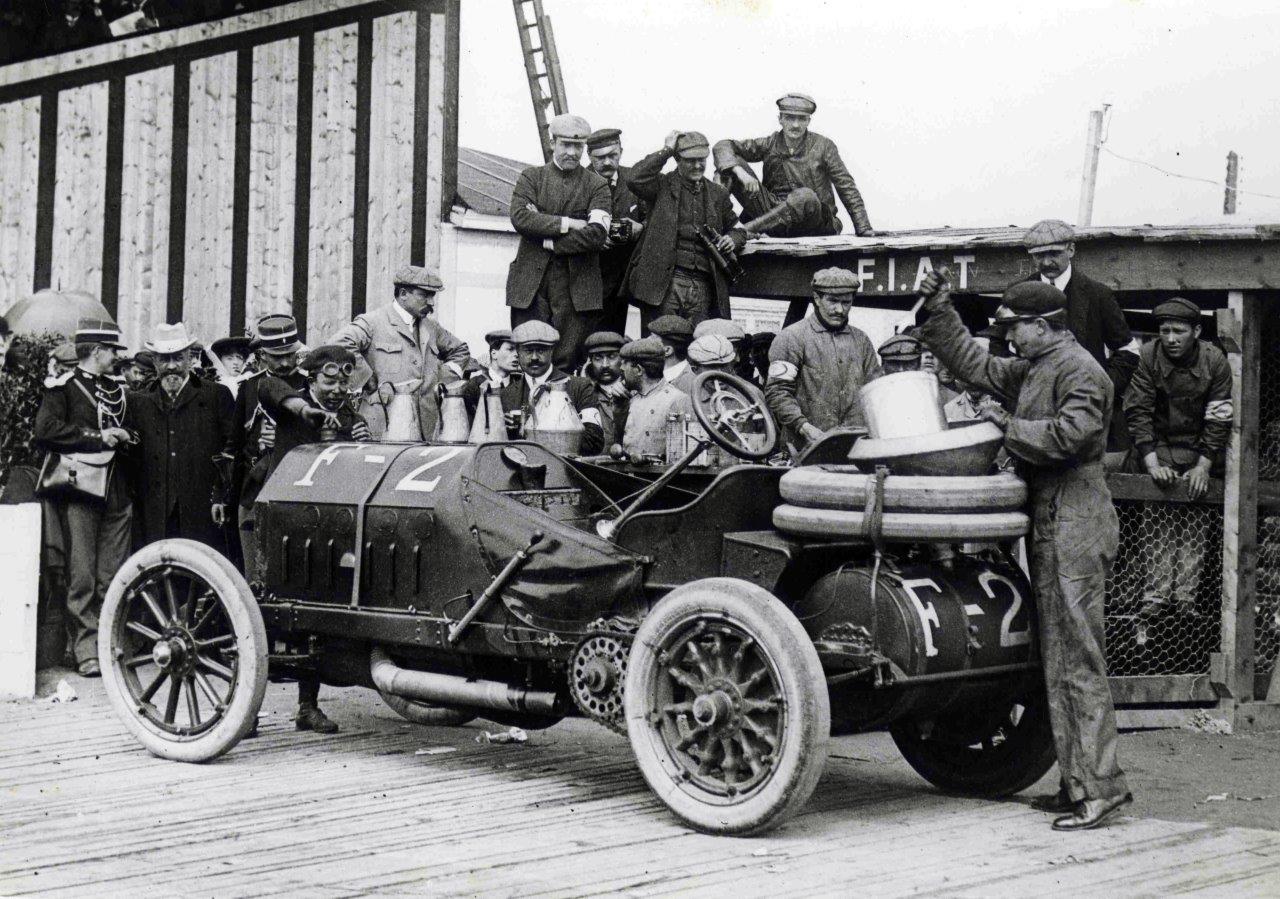
The arrival of motor sport had its roots in France where long distance races were organised that became referred to as ‘Grand Prix’, events that lasted several hours and took place on public roads. In the case of the 1907 French grand prix, the circuit, based in Dieppe, consisted of ten laps around a 77 kilometre course with the first car departing at six in the morning with the 38 entrants leaving at one minute intervals. Such was the popularity of the race it required 700 gendarmes and 4,500 soldiers to line the course to keep spectators and other vehicles from straying into the path of oncoming cars. Safety procedures did not apply during the earlier practice days when two drivers were killed, one colliding with a cart. Entries were received from several countries including three cars from the Italian F.I.A.T. (Fabricca Italiana Automobili Torino) company. The drivers included Vincenzo Lancia and the talented Felice Nazzaro who, at the age of 18, joined FIAT and won his first major race one year later. The starting time was decided by ballot and Nazzaro started in fourteenth place. He maintained a steady pace during the opening laps, gradually moving up the leader board as other cars retired and by the fifth lap he was third, one minute behind his team-mate Lancia and four minutes behind the Lorraine-Dietrich of the French driver Arthur Dumay. Nazzaro increased his pace, passing Lancia on lap 7 to chase Dumay who, to the dismay of the huge crowds, retired on lap 9 when the gearbox broke. Nazzaro inherited the lead, setting the fastest time on the final lap to keep ahead of the second placed Renault of Ferenc Szisz. The photograph shows Nazzaro and his mechanic refuelling the tank and checking the radiator of the FIAT during a pit stop en route to victory in the 1907 Grand Prix de l’Automobile Club de France.