The precise pedigree of this 1964 Saab 96 is uncertain, but it appears to have spent its formative years in New Mexico, where it was sold new in Albuquerque. It was likely driven last around 1977, and until a couple of years ago, it spent most of the in-between time stored outside, where it may or may not have been caught in a flood and bobbed, possibly upside-down, along Main Street.
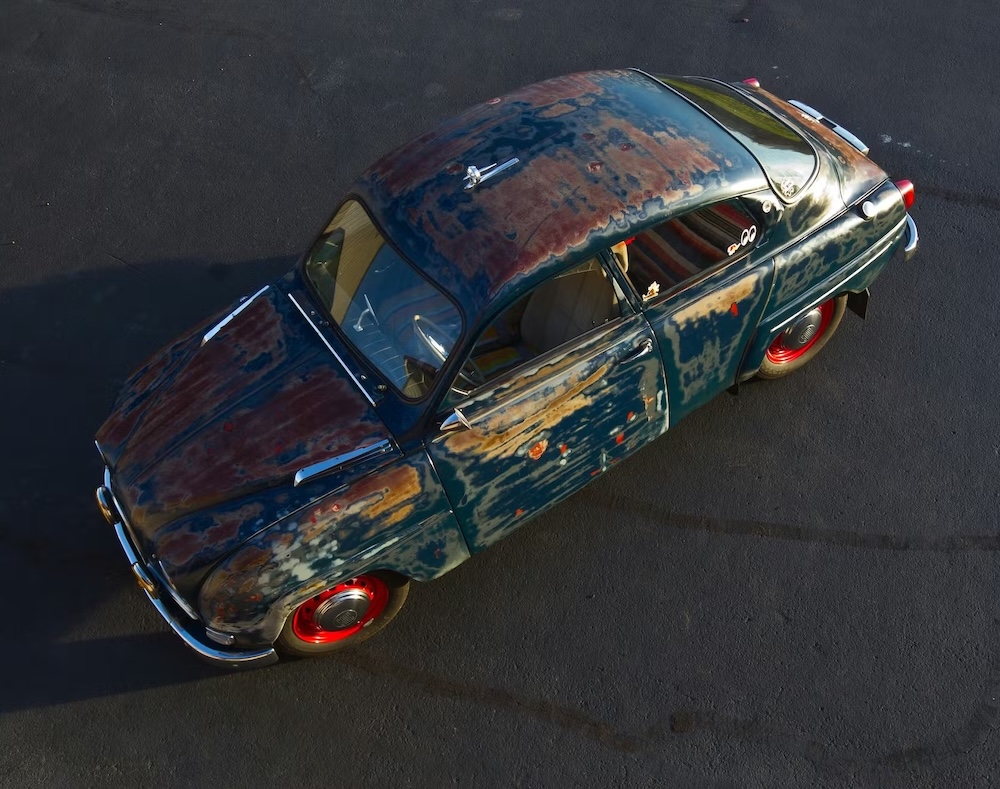
There’s evidence of that, said its restorer, well-known marque expert Jimmy Smart, who has a Saab shop in Santa Fe. When Smart got the car, it was full of silt, indicative of a flood. And there were marks on the roof that appeared to have been left by barbed wire, suggestive of the heartbreaking adventure of the Saab scraping along, wheels akimbo, across a rancher’s fence.
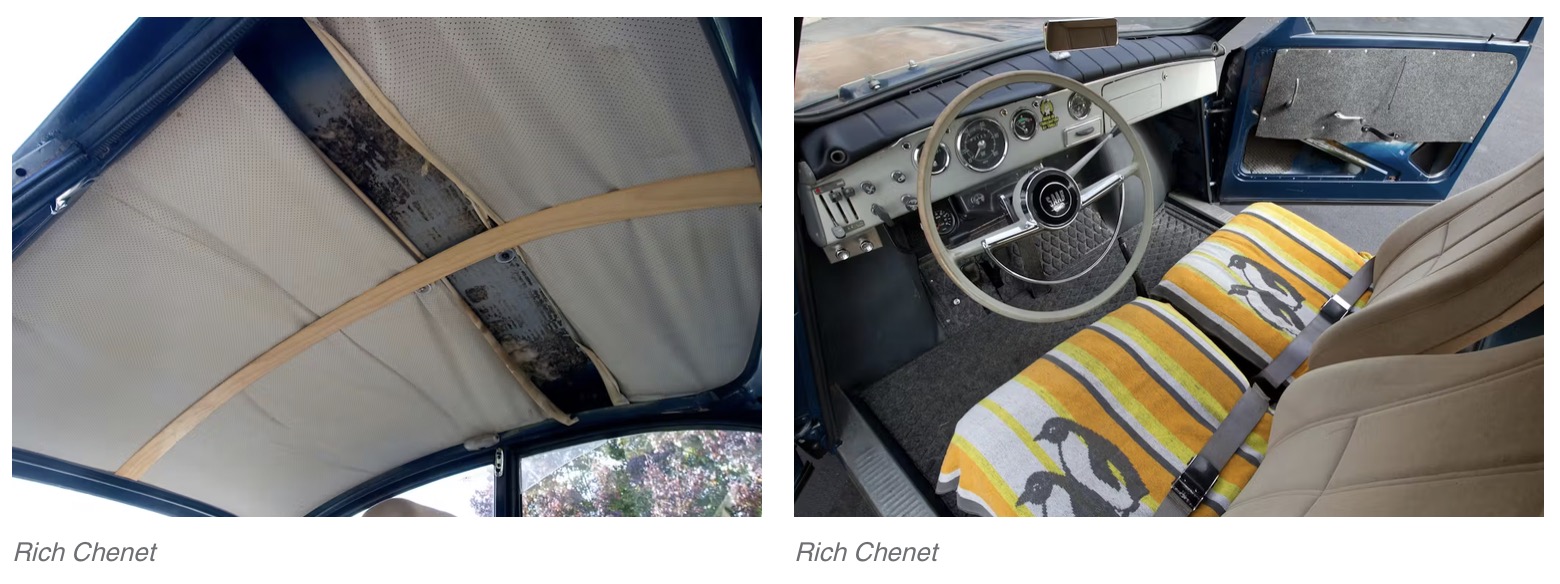
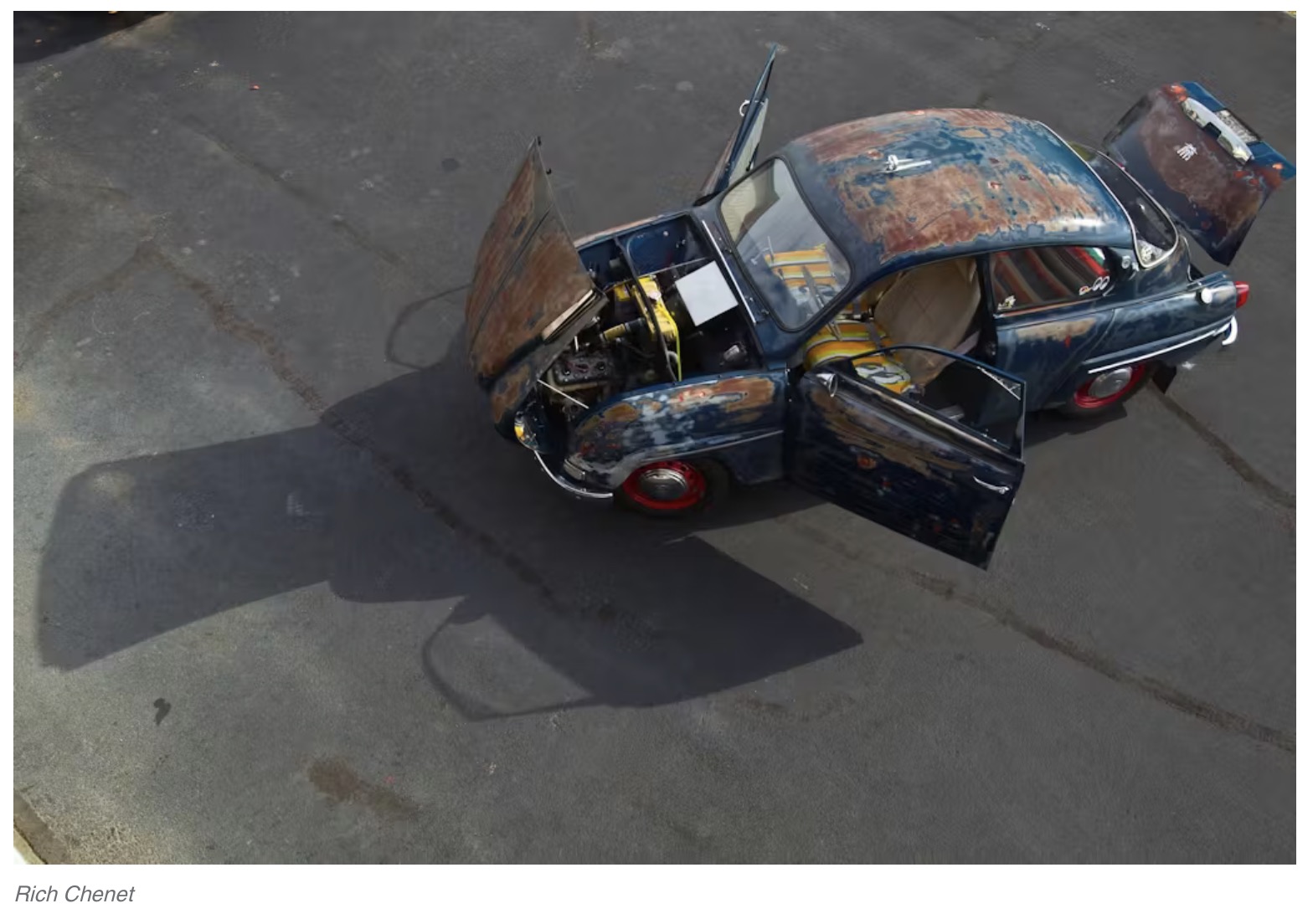
Smart repaired many things wrong with the 96, but not all. Apparently it had been repainted at some point, in a color a past owner didn’t much like, so he or she began sanding. He or she never finished, hence the patina.
Which, almost inexplicably, drew the attention of Saab enthusiast Rich Chenet. Calling Chenet an “enthusiast” is akin to calling Fatty Arbuckle “chubby:” Chenet refuses to count how many Saabs he has on his farm in Pennsylvania, but, he says, “a friend counted them, and he said I have about 60.” Entirely possible, Chenet admits. After all, he has 18 that “are insured, and I drive them. Then there are about seven more that need a month or two of work, and they’ll be done. And maybe seven more that are rust-free and restorable. Which I’ll never get to. I probably need to sell some cars.”
He was once written up in the Wall Street Journal in a story titled, “No One’s Sweeter on Saabs Than This Guy.” That was in 2017. He only had 40 of them then.
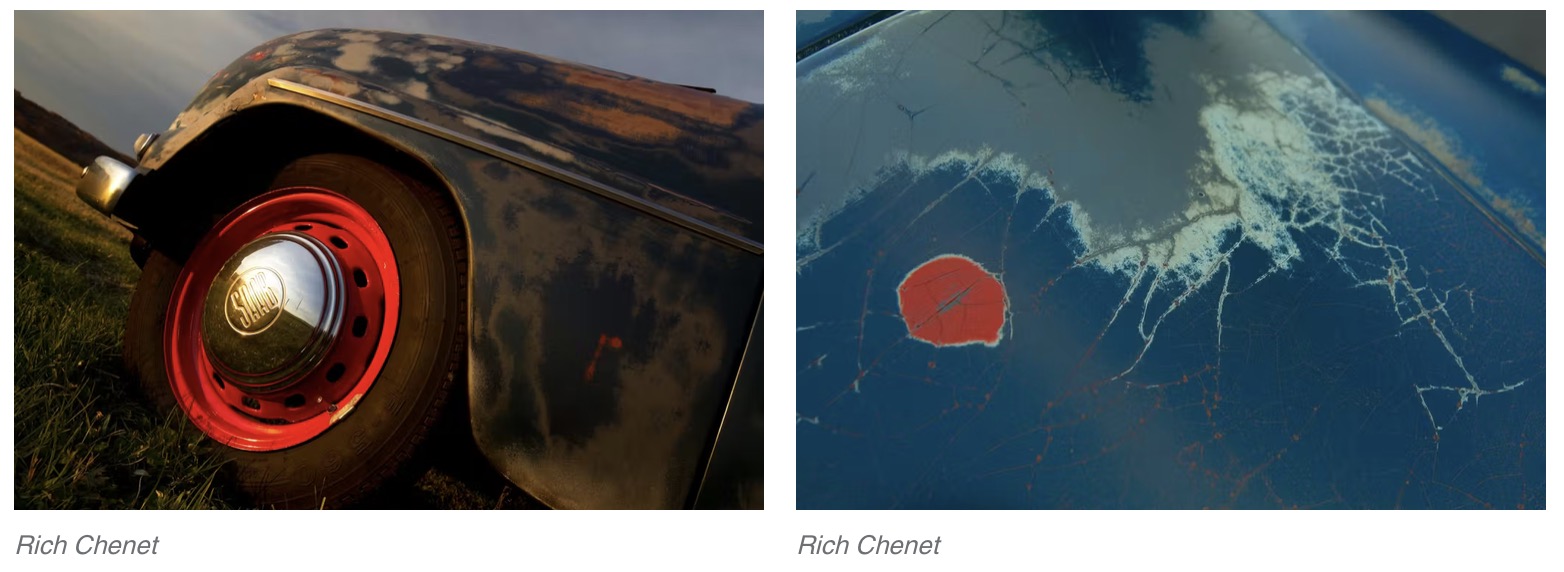
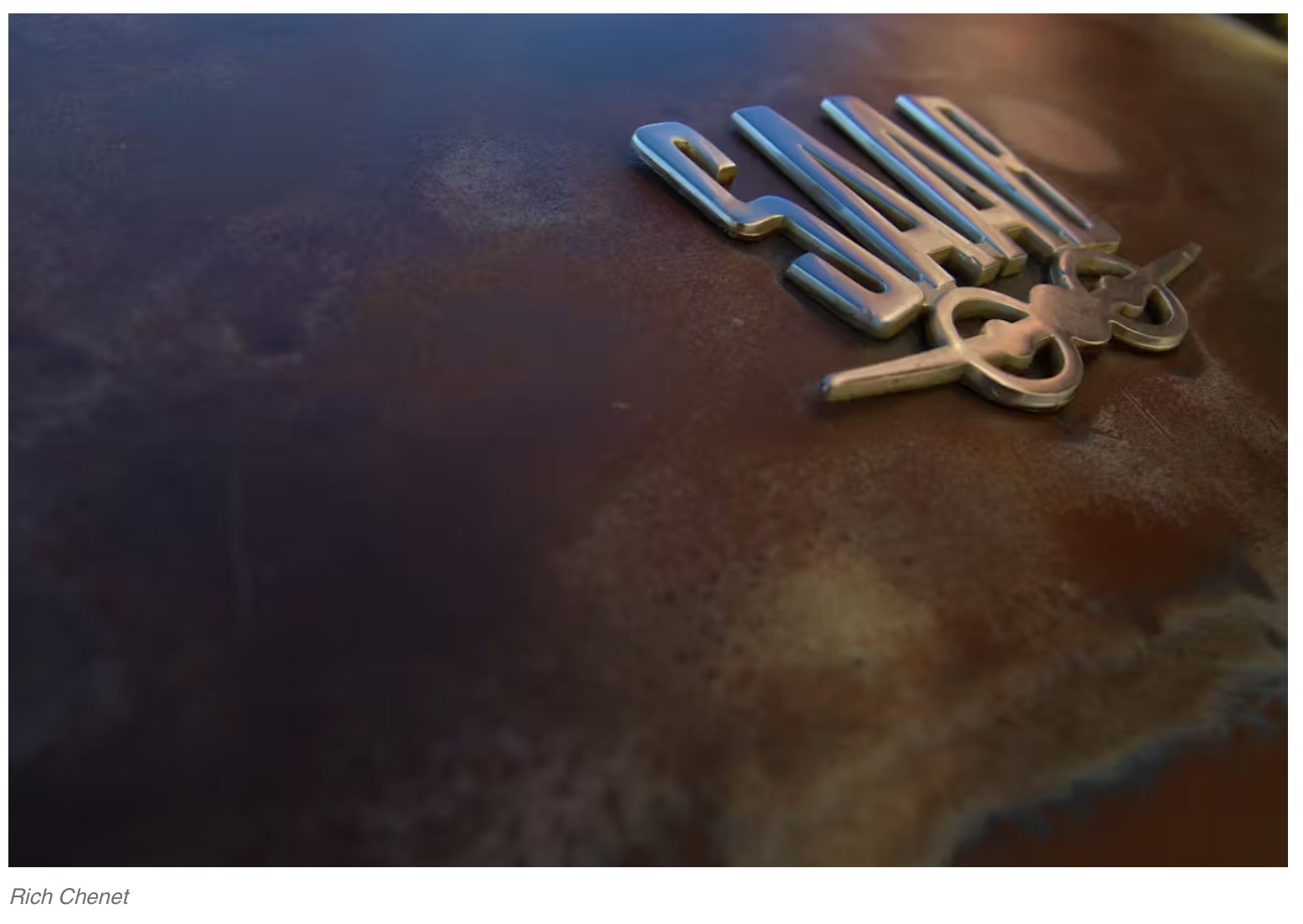
If Rich Chenet’s name is otherwise familiar, regular readers of magazines like Car and Driver and Road & Track and Cycle World have certainly seen his work. Chenet has traveled the world photographing cars, both of the civilian nature and bespoke exotics, plus hundreds of race cars, and probably as many motorcycles. Google him.
Even semi-retired, Chenet’s daily rate is too rich for Hagerty’s blood. So we talked him into shooting this story for a fraction of his regular fee, and in return we’d write about his Saab 96. Everybody’s happy!
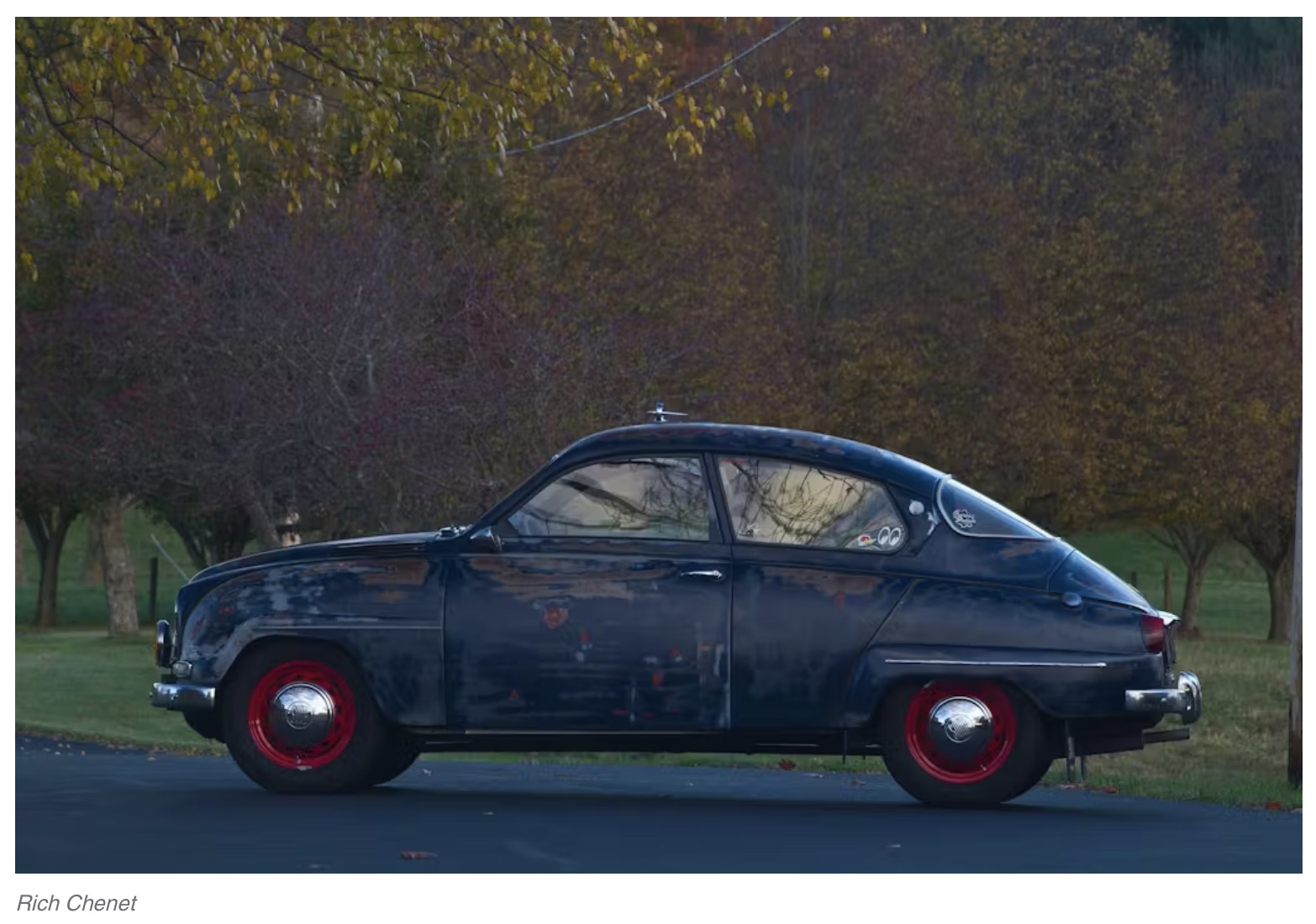
Anyway, back to the multi-hued 96: It first came to Chenet’s attention in the fall of 2023, when it went up for sale on Bring a Trailer. Chenet frequently appears at car shows with a restored Saab or two and says he is often asked, “So you’ve probably had some two-stroke Saabs?”
“And I had to say no, I haven’t,” he says. Two-stroke, for fledgling enthusiasts, means an engine that operates on two, rather than four up-and-down strokes, with the central tipoff being that two-strokes sound funny, and they don’t have a normal recirculating oil supply. You must mix specially burnable two-stroke oil into the gasoline to lubricate the bearings.
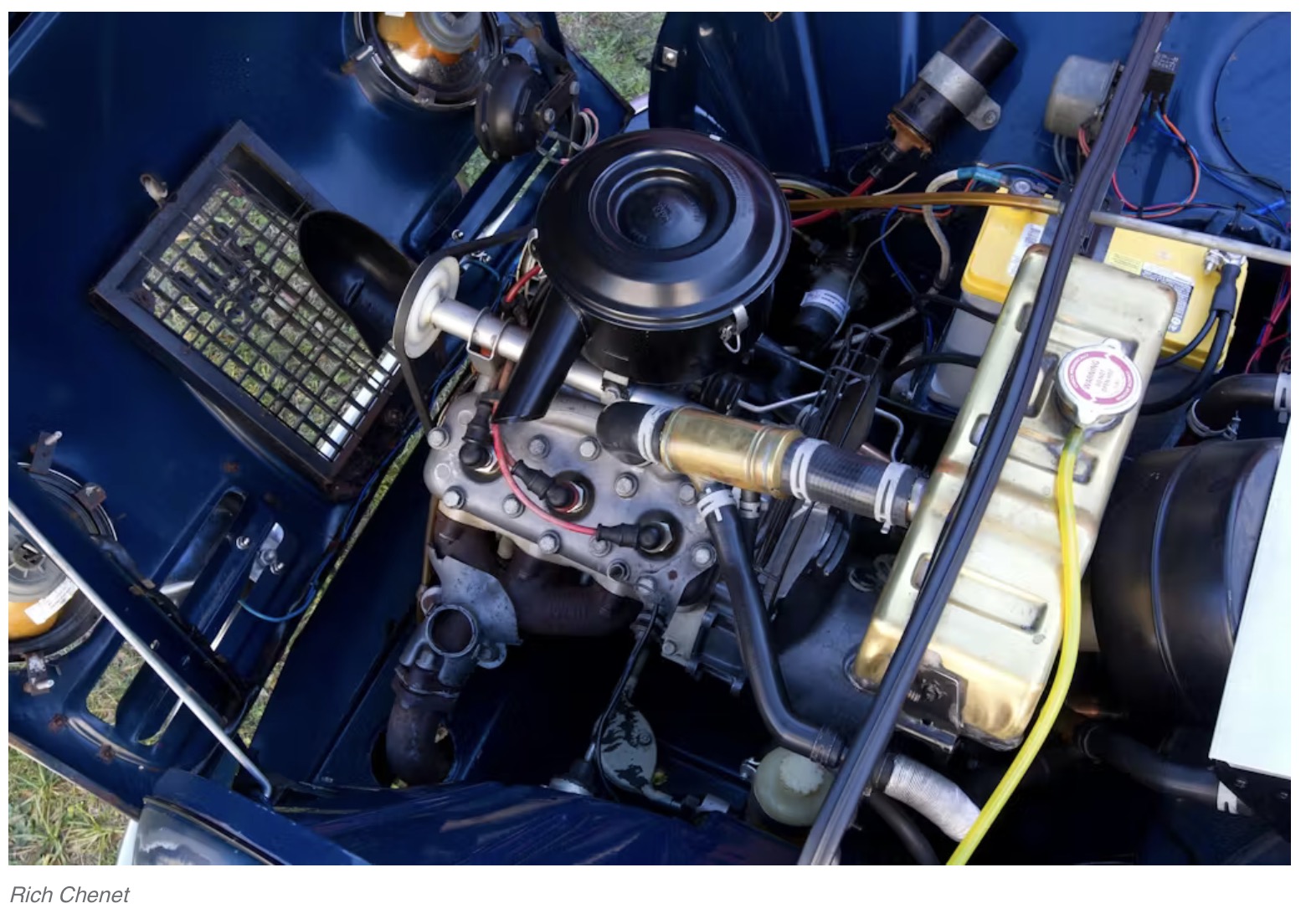
That is done one of two ways: There’s the relatively modern invention, like on my 1970 Suzuki, that uses a separate little tank for the oil, which is then injected into the engine. Prior to that, you had to manually mix oil into the gasoline, in a ratio of about 50 parts gas to one part oil. Some chain saws are still lubricated that way, but not many cars. Unless you buy a Saab built no later than 1980.
Which is exactly what Chenet was about to. He followed the auction online, checkbook at hand, until there were about two hours left. “Then I turned off the computer. I figured I had enough Saabs.” The next morning, he logged on to see how much the muy-patinaed Saab from Nuevo Mexico sold for. “I was beside myself. It was $7000. You can’t even buy a set of wheels for a Porsche for $7000!”
Oh, well. His thoughts turned to other things, such as helping his very understanding, tolerant wife run their hobby farm.
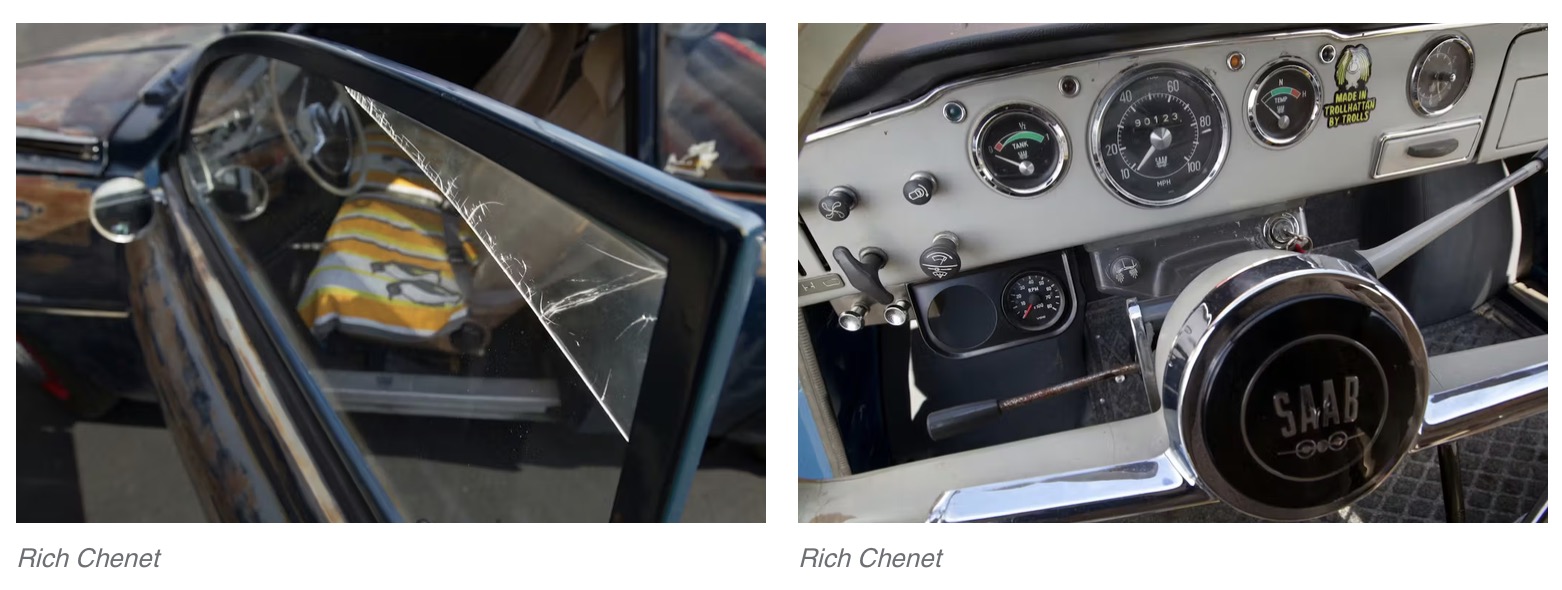
Until a few months ago. “I saw it for sale on Facebook. And I bought it.” Turned out the new owner, who had made some welcome modifications, including replacing the date-stamped 2001 Kuhmo tires for substantially newer ones, lived in Breckenridge, Colorado, about 9600 feet above sea level. For an 841-cc inline-three-cylinder that only makes 44 horsepower at the very bottom of the mountains, it just couldn’t get enough air at nearly 10,000 feet, especially with the clutch work involved to effectively operate the three-on-the-tree manual transmission.
This time, Chenet bought it sight-unseen, for two reasons: One, “I know how Jimmy Smart restores Saabs, which is the way I do it—right.” And two: “I just liked the way it looked. I have enough shiny cars.”
Chenet hired a shipper to pick up the car in Colorado, and it arrived without a scratch, not that you’d be able to tell. Except the clutch was about gone, with the kiss of death probably bestowed by the shipper, who was slipping it a lot trying to back the 96 up the ramp into the truck. “No big deal,” Chenet says. “It’s simple to fix. The whole car is that way. It’s built like a bicycle.”
Chenet repaired some rust on the lip of the trunk, and now he’s enjoying a Saab that is nothing like his other five dozen. “It’s a blast. We have hills here, and it goes right up them. Very durable car, very rugged, good in the snow.” You just get it rolling, then peg the tachometer to about 5500 rpm, and keep your foot on the floor. Left-foot brake in the unlikely event you need to slow down, should you somehow get going too fast.
Surprisingly, parts aren’t really that hard to find; there are still a lot of early Saabs in Sweden, and in some countries of Europe.
Chenet will mention to anyone who listens that his 1800-pound, 1964 Saab is pretty much identical to the 1962 and ’63 Saab 96s that won the Monte Carlo Rally those years, with an engine smaller and less than half as powerful as the slowest new Harley-Davidson (a minus), but with Swedish rally driver Erik Carlsson at the wheel (a huge plus). If you never met Carlsson, who died in 2015, or went driving (and later, drinking) with him, it’s your loss: A certified legend, lifelong Saab cheerleader, married to Pat Moss, younger sister of Sir Stirling Moss, a pretty fair rally driver herself…
As for Chenet and his 96: “I was surprised at the power, once I learned the right way to drive it. The car makes neat sounds. It goes pretty well. It’s funky. An art car, really.” If you want to hear what a Saab two-stroke sounds like, check out Jay Leno’s 1958 three-cylinder Saab.
“Like a hive of bees coming at you,” Leno says. “A wonderful, and unusual, car to drive… Kind of a thinking-man’s economy car,” once the favored transportation of college professors who smoked pipes and wore Earth shoes. And “even people who smoked marijuana!” Leno says, making little quote marks with his fingers. “They drove Saabs. There was a certain sort of intellectualism about them.”
Rich Chenet will smile at that. How could he not?
Report by Steven Cole Smith for hagerty.com