Thanks to a relaxed approach to the rule book regarding race car construction and engine capacity, during the 1960s the world of motorsport bore witness to some of the most memorable prototype sportscars ever built. Spectators were treated to the sights and sounds of remarkable cars; Ferrari P4, Ford GT40 and Lola T70 to name but a few but one in particular stole the headlines when it arrived – the Chaparral.
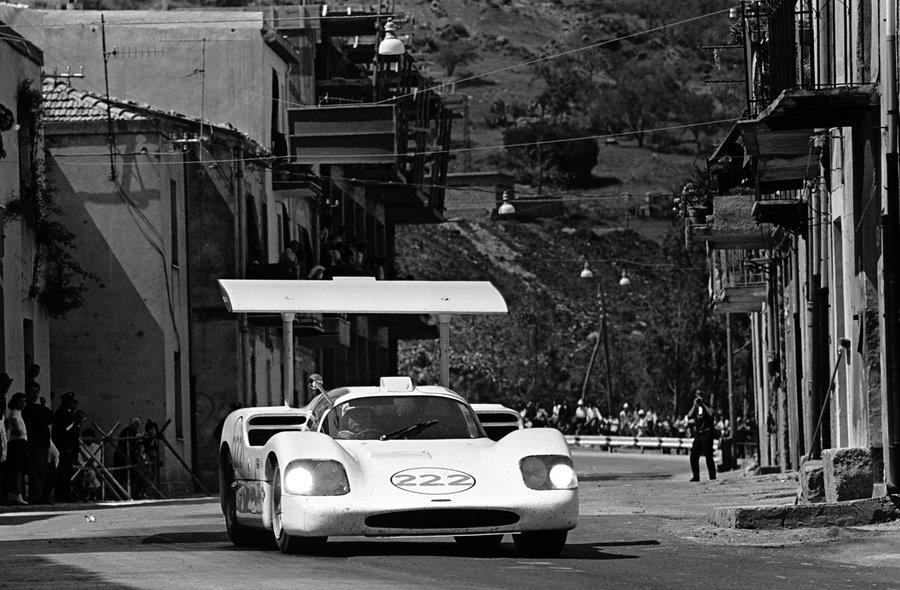
Painted white, the cars were constructed by Jim Hall and Hap Sharp in the USA between 1962 and 1970 and were powered by General Motors big-block engines supplied by Chevrolet. Rather than follow the same route as other race car manufacturers, Jim Hall made a close study of aerodynamics, in particular downforce from reverse-lift structures (wings), a technology that was gradually coming to the attention of automobile designers. Of the Chaparrals that emerged from the workshop in Texas, the model that created the headlines was the 2F, a prototype powered by an aluminium 525hp 7-litre engine matched to a 3-speed automatic gearbox and adorned at the rear by a full-width wing mounted high above the bodywork on tall struts that were attached to the rear suspension uprights to create downforce directly onto the rear tyres. The angle of the wing was altered by the driver who used his left foot to change the angle from flat on the straights to angled as required coming into the corners.
It made its World Championship debut at Daytona in 1967 where it upset the status quo by qualifying on the front row, second only to Dan Gurney’s Ford and ahead of the Ferraris and Porsches. It demonstrated its formidable speed at every race but issues with engine and gearbox development often resulted in retirement. It was not until the last round of the championship at Brands Hatch that the Chaparral 2F finally reccorded its first victory, driven by Phil Hill in his final race and Mike Spence who, shortly after, died during practice for the Indianapolis 500. The photograph shows the car competing in an event that most people thought it would miss – the Targa Florio in Sicily. This long, punishing race, much of it on narrow unmade roads, was not suited to such a ‘fragile’, wide, powerful car but Hill and Hap Sharp drove at a cautious pace (to help preserve it for the next race) for eight of the nine 72-kilometre laps until a punctured rear tyre forced them to retire from fourth place, but not before they had won over the Ferrari-obsessed partisan crowd.
Photocredit: McKlein Archive